The combination of swathing canola too early (low seed-colour change) and swathing during a stretch of hot weather can lead to rapid curing that leaves green counts elevated.
By leaving the crop standing until 60% seed colour change on the main stem, this should reduce the amount of green immature seeds on side branches, which will reduce the green-seed risk in the combined sample.
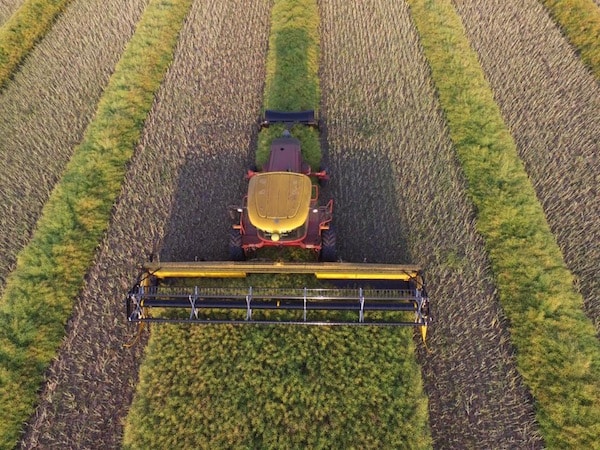
Swathing. Photo credit: Kristen Phillips
The natural chlorophyll-clearing process
As canola plants dry down, the rate of chlorophyll clearing (when seeds turn from green to yellow) is quite rapid at around 30% seed moisture. As seed moisture drops below 20%, the pace of chlorophyll clearing slows and by 10%, green clearing will slow to near nil. In fast drying conditions, moisture loss outpaces chlorophyll clearing and it can leave harvest-ready seeds with high green counts.
When these conditions lead to low-moisture, high-green seeds, those seeds will need to take on moisture again and get back up to around 20% moisture for green clearing to resume. Rain on swaths can bring seed moisture back up near 20% for a short while, but it make take a few rains as well as warm temperatures to make a difference.
After all the unharvested canola last year, growers may have a little less patience for waiting. They will want to weigh the economic risk of combining lower-grade canola now or leaving it out in hopes it moves up a grade. Another consideration: the longer a crop sits out, the higher the probability of encountering a severe weather event.
A note on an outdated “rule”: Past research found that 30% seed moisture correlated with approximately 30% seed colour change (SCC). With newer hybrids and plant populations that are now typically much lower than when this research was done, this same correlation may no longer apply when a lot of the yield is contained in less-mature side branches. The seed moisture at 30% SCC may be more like 40-50%, but further study is needed to determine this.
Tip: A set of sieves (at a cost of around $150) can help with accurate green seed counts. The sieves eliminate shriveled and damaged kernels from the roll.
Further reading:
Swath timing for higher yield
Swathing scenarios: Hot weather, too early, uneven crop, aster yellows
High green? Pros and cons of waiting to combine
E-newsletter sign up +
Key Topics

Agronomy Fundamentals
Explore articles on the best management practices for yield, profitability and sustainability:
Related Articles

August 28, 2024
Questions of the Week
How much will blackleg infection cost? | How long between spray and swath? | Prepping for next year’s success now | Swath timing matters
August 21, 2024
Questions of the Week
Is blackleg more concerning this year? | Still too early to swath? | This week’s late-season pests? | Why are so many canola plants
August 14, 2024
Questions of the Week
Verticillium stripe, sclerotinia or blackleg? | Is that bug a problem? | What’s too early for swathing? | Manage kochia now or at harvest?