Canola growers and agronomists can use these steps to improve canola yield (as much as possible) in dry, drought-like growing conditions.
3 essentials for clubroot management
The three best tools to prevent and manage clubroot are scouting, a minimum two-year break between host crops, and genetic resistance.
6 basics of blackleg management in canola
Blackleg disease is common in canola across the Prairies. Keep blackleg levels low with the following six management steps.
8 best practices to maximize canola seed survival
Follow these tips to improve emergence percentage so more canola seeds contribute to yield and profitability.
9 agronomy tips to help increase canola profit
These agronomy practices can help farmers and agronomists improve canola profit at little to no added cost.
A second pass of in-crop herbicide: Critical or cosmetic?
A well-established, competitive canola crop may not need a second application of in-crop herbicide. When does a second pass make sense?
Agronomy priorities: More canola, more profits, lower emissions
Work through the checklist of key best practices for each priority to identify which ones are applied on farm and which ones warrant consideration.
Agronomy: Accurate diagnosis for effective treatment
Make an accurate diagnosis before taking corrective action. Consider all possibilities and work through a process of elimination.
Bertha armyworm management in canola
Bertha armyworm outbreaks tend to occur in cycles. At high numbers, they can eat a lot of pods in a short amount of time.
Broadcast seeding canola: Tips
Broadcast seeding can work in a pinch when the calendar ticks toward June and fields are still too moist for a farm’s regular seeding tool.
Cabbage seedpod weevil management in canola
Spraying is rarely recommended before the canola crop reaches 10% flowering stage. Three reasons to wait are….
Calculate a yield target based on profit
The most profitable canola yield target will vary by field and by year. Crop plans, input decisions and profit outlooks benefit from an appropriate yield target for each field each year.
Can we heat-proof canola?
Highs of 27°C and above can disrupt pollination and seed production in flowering canola. No protective practices have a proven track record.
Canola as feed – economics and tips
Canola can be used for cattle feed. This article explains feed value, feed prices and other considerations for feed versus seed.
Choose the right cultivar for each field
Cultivar decisions based on the opportunities and challenges in each particular field can improve productivity and profitability of canola.
Clubroot – How to estimate yield loss
Estimate canola yield loss from clubroot with a disease severity index (DSI) measurement eight weeks after seeding the crop.
Conditioning tips for stored canola
Cooling hot grain within the first 24 hours is important for safe long-term storage. This also removes moisture that sweats from all canola.
Cutworm management in canola
Cutworms are a common crop pest of the Canadian Prairies. When scouting shows crop loss at threshold, consider a targeted insecticide spray.
Equipment sanitation: Why and how
Soil on equipment can spread major pests, including clubroot and herbicide-resistant weed seeds. Equipment sanitation reduces the risk.
Factors in the sclerotinia spray decision
The decision to apply a fungicide to prevent sclerotinia stem rot may hinge on answers to these four questions…
Factors that increase canola storage risk
Factors that increase the risk of spoilage for stored canola are high moisture, high temperatures, green seeds and dockage.
Fall frost hits canola. What to do?
Default to waiting. Don’t make a snap decision to swath. Before taking any harvest action, start with this sequence…
Fall weed control
Fall can be an excellent time for weed control, especially perennials and winter annuals moving resources to their growing points and roots.
Flea beetles management in canola
This article has tips for better canola crop establishment and tips to improve results for in-crop insecticide applications.
Grasshopper management in canola: Thresholds, identification, and control strategies
Whether they’re young nymphs or mature adults, if grasshoppers are present at numbers and crop damage is getting worse, spray.
Green seed – causes, management and storage risk
Canola seeds can lock in green when frost or high temperatures stop or interrupt the chlorophyll-clearing process.
Hail – From emergence to harvest
This article describes the potential yield impact from hail on canola at four growth stages – seedlings, four- to six-leaf, flowering and podding. Hail early in the season tends to have a much lower yield impact than hail late in the season.
Harvesting thin, low-yielding canola: common questions
A thin, drought-stressed canola crop – where plants are shorter, canopy is open and yield potential is low – will require some extra considerations at harvest to preserve yield and limit any extra costs.
Herbicide carryover and sprayer contamination
Canola plants are sensitive to off-target herbicide damage through herbicide carryover and sprayer contamination. This article has five sections to identify and avoid this damage. Herbicide carryover damage Canola injury from herbicide residue in the soil can occur in fields with a history of Group 2, 4, 5 and 14 herbicide applications. Typical herbicide carryover symptoms in canola Situations that …
How much fertilizer does canola need?
A fertilizer program based on yield goals, 4R practices and current soil nutrient levels will improve profitability.
How to assess leaf area loss from flea beetles
The action threshold for flea beetles in canola in Canada is an average leaf area loss of 25 per cent or more. To make that assessment…
How to check bins and bags for spoilage
Monitor bins closely during the first six weeks after harvest and then continue to check stored canola regularly until delivery. Here’s how.
How to count canola plants and explain low numbers
Canola plant counts at around the two-leaf stage will demonstrate the success (or not) of the seeding operation.
How to get acres counted as 4R
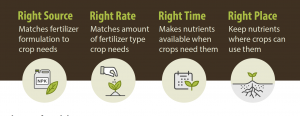
With acres counted under 4R Nutrient Stewardship, canola growers can demonstrate their commitment to improved nutrient use. Part one of the article shows how to get acres counted. Part two describes basic-level 4R practices for nitrogen and phosphorus in Western Canada.
How to identify verticillium stripe
Verticillium stripe, a disease of canola in Canada, causes yield loss in some fields. This article has identification and management tips.
How to manage herbicide-resistant kochia
Manage herbicide-resistant kochia with effective tank mixes, patch mowing, combine weed-seed destroyers and fall Edge.
How to manage verticillium stripe
This article outlines what we know (and mostly don’t know) about potential verticillium stripe management. In most situations, we don’t have Prairies-based research to confirm the practice or make specific recommendations. The first known case of verticillium stripe on the Canadian Prairies was in Manitoba in 2014. The soil-borne disease, caused by the pathogen Verticillium longisporum, has been a long-term …
How to reduce combine loss
Canola growers can lose a lot of crop if the combine isn’t adjusted properly. This article has tips to measure and reduce loss.
Integrated weed management: Best practices
Integrated weed management practices can protect herbicide efficacy. This article describes three categories of IWM practices.
Lygus bugs management in canola
Sweep for lygus bugs at late flowering and pod stages of canola. The standard threshold is 20-30 adults and late-instar nymphs per 10 sweeps.
Manage gophers in early spring
The best time to manage Richardson’s ground squirrels, AKA gophers, is late winter and early spring as they emerge from their burrows.
Manage residue with the combine alone
Canola establishment benefits from a uniform spread of crop residue. Ideally, you can do the job with the combine alone.
Many reasons for missing pods
Disruptions and malfunctions in bud formation and pollination can result in blanks on canola stems where pods should be. Here are the common causes.
Pre-harvest disease scouting
Canola plant diseases are easier to identify and diagnose just before harvest. Use results to plan disease management for next year.
Pre-harvest products and how to use them
Canola growers use pre-harvest sprays for weed control, desiccation and uneven crop. This article provides specifics for each product option.
Pre-seed burnoff: Tips for best results
Pre-seed burnoff is a good way to remove perennial and winter annuals weeds that are growing quickly and taking up moisture and nutrients.
Precision fertilization: 3 low-cost tests to optimize canola production
Try these low-cost, low-risk fertilizer tests for valuable new observations on yield potential, hidden soil nutrient issues and right rates.
Quick tips for on-farm trials
Farms can run research trials to test how a particular practice or product performs in the local environment. Here are the steps…
Right rates for seed-placed fertilizer
The risk of seed-placed fertilizer comes from the nitrogen component of ammonium phosphate, ammonium sulphate and all nitrogen fertilizers.
Rotation for risk management
Breaks of at least two years between canola crops will reduce risk from clubroot and blackleg diseases, reduce selection for weed resistance, and increase crop yields.
Seeding canola in dry conditions
When seeding into dry soil conditions from March until mid-May, the recommendation to seed canola no deeper than 1” still applies. Here’s why…
Shopping for an agronomist
A farm decides it could benefit from outside advice on crop rotation and fertilizer rates, or on scouting and pest management. Here are some questions to ask a prospective agronomist.
Soil sampling – timing, technique, interpretation
Soil sampling just prior to seeding is ideal, but fall soil sampling can be almost as accurate and has various advantages.
Spray early: Economics of early weed control
Early in-crop weed control will yield more than late control almost all the time. To err on the early side is the safest economic approach.
Spraying tips for tough conditions
Tips for spraying after a frost, in the wind, in cool conditions, in dusty conditions, and before a rain.
Spring frost: Did the crop survive?
After a frost, it can take a few days to accurately determine how many plants survived. Be patient.
Spring frost: When to resume weed control?
If tissue damage is greater than 40 per cent of total leaf area, allow new leaves to grow before making herbicide applications.
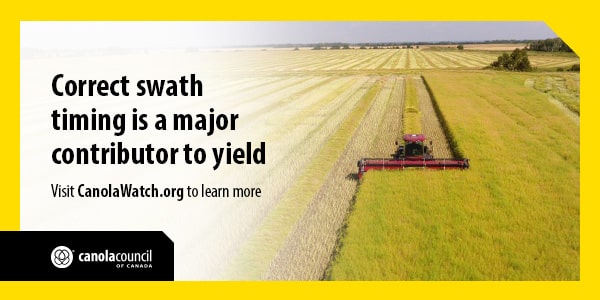
Swath later for higher yield
Canola fields swathed at 60 per cent seed colour change (SCC) on the main stem can yield eight per cent more than fields swathed at 30 per cent SCC.
Target 5 to 8 plants per square foot
The canola plant population target of five to eight plants per square foot is a safe target to balance yield potential and economics.
Test your sprayer water
Low-quality sprayer water reduces herbicide performance. Hard water ions, for example, tie up glyphosate molecules and make them ineffective.
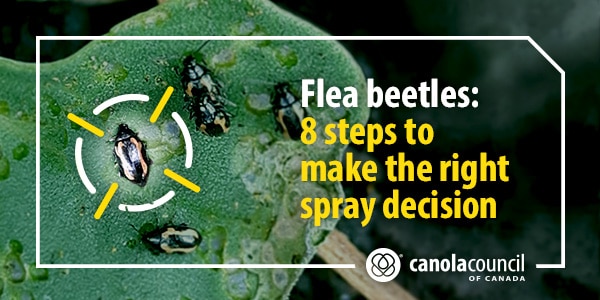
The flea beetle spray decision: 8 steps
Slow-growing crops under intense flea beetle pressure may require foliar insecticide. Here are 8 steps to make the spray decision.
The path to variable (optimum) rate application
Variable rate (VR) or “optimum” rate application aligns with the potential of productivity zones within each field, ideally increasing profit and environmental sustainability.
Tips for drying tough and damp canola
Aeration can be enough to dry tough canola to safe storage levels – as long as air has “capacity to dry”. Damp canola will require heated air drying.
Tips to apply nitrogen and sulphur in season
In-season application of nitrogen or sulphur can make sense in some circumstances. This article describes how to do it.
Tips to increase soil pH for crop nutrition and clubroot
Ideal soil pH for canola is 6.0 to 7.0. Fields with pH below 5.5 may see an economic benefit from lime. This article provides tips.
Tips to straight combine canola with success
Ideal canola crops for straight combining, situations where swathing may be preferred, pre-harvest aids, headers, combine settings.
Watch for and report new canola pests
Learn which emerging canola pests to watch for on the Canadian Prairies, what symptoms to look for and who to contact if you find an unfamiliar insect or unusual crop damage.
Weed control strategies for each HT system
Here are strategies to improve weed control results for each herbicide-tolerant (HT) canola system, including Roundup Ready, Liberty LInk and Clearfield.