Cabbage seedpod weevils will feed on buds, but spraying is rarely recommended before the canola crop reaches the 10% flowering stage. Three reasons to wait for 10% flowering:
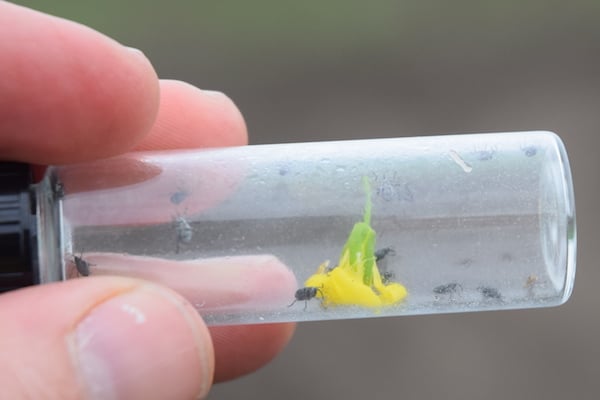
- Economic loss from cabbage seedpod weevils (CSPW) is due almost entirely from weevils laying eggs in young pods. (One egg per pod.) Larvae hatch, feed on a few seeds, then dig a small hole in the pod and exit.
- CSPW move very easily from field to field. Spraying weevils on buds on early canola fields will take out those particular weevils, but by early flowering — which is the critical control stage — a whole new group of weevils will be back. A second spray be required, and some insecticides cannot be sprayed twice in one season.
- Low levels of bud feeding can cause a defence response in healthy plants, causing them to flower longer. This can increase yield when weather conditions in mid to late summer allow for good compensatory growth.
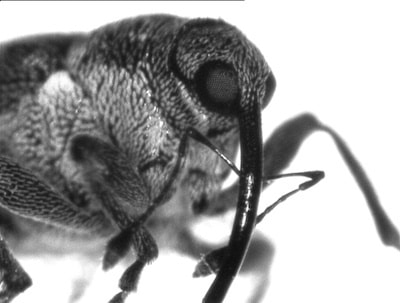
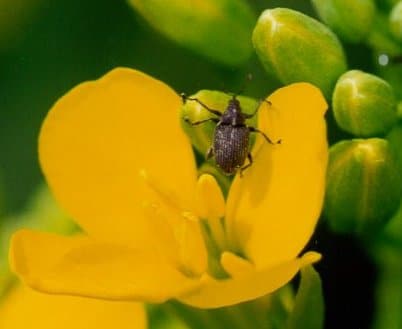
Scouting
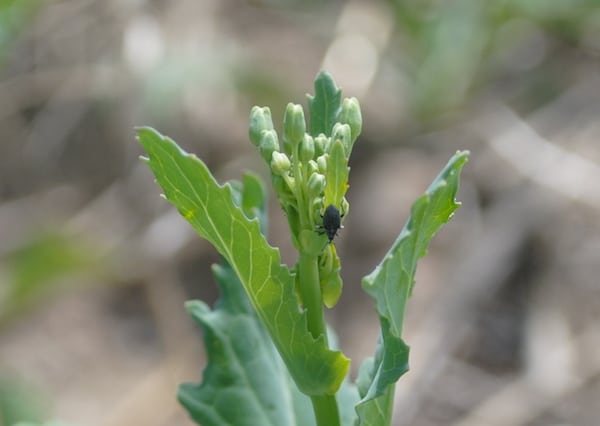
Scout at 10-20% flower (or approximately one week after first flower) using a sweep net. The economic threshold is 25-40 CSPW per 10 sweeps generally across the field. Use proper sweep net technique and make ten 180° sweeps at each location.
Agriculture and Agri-Food Canada research scientist Hector Carcamo says two sets of two paired samples (four sets in total with 10 sweeps per set) can provide a good assessment of weevil numbers. However, the two sets need be in different parts of the field. Do one set near the field edge and the next another 50 metres (paces) into the field. Repeat this at the opposite end of the field or from a different field access point. Large difference in CSPW numbers between the four sample sets may indicate continued movement of CPSW into the field and the need for continued scouting.
Cabbage seedpod weevils enter a field from the side and work their way to the middle. Scouting borders of fields twice a week may allow you to catch their first arrival, possibly allowing adequate control with a perimeter spray of the outside edges of the field. Shelterbelts and fence lines are a good clue as to which side might be first. Also, continue to scout after application if relying on perimeter sprays (keeping in mind safe field re-entry times) in case re-invasion occurs.
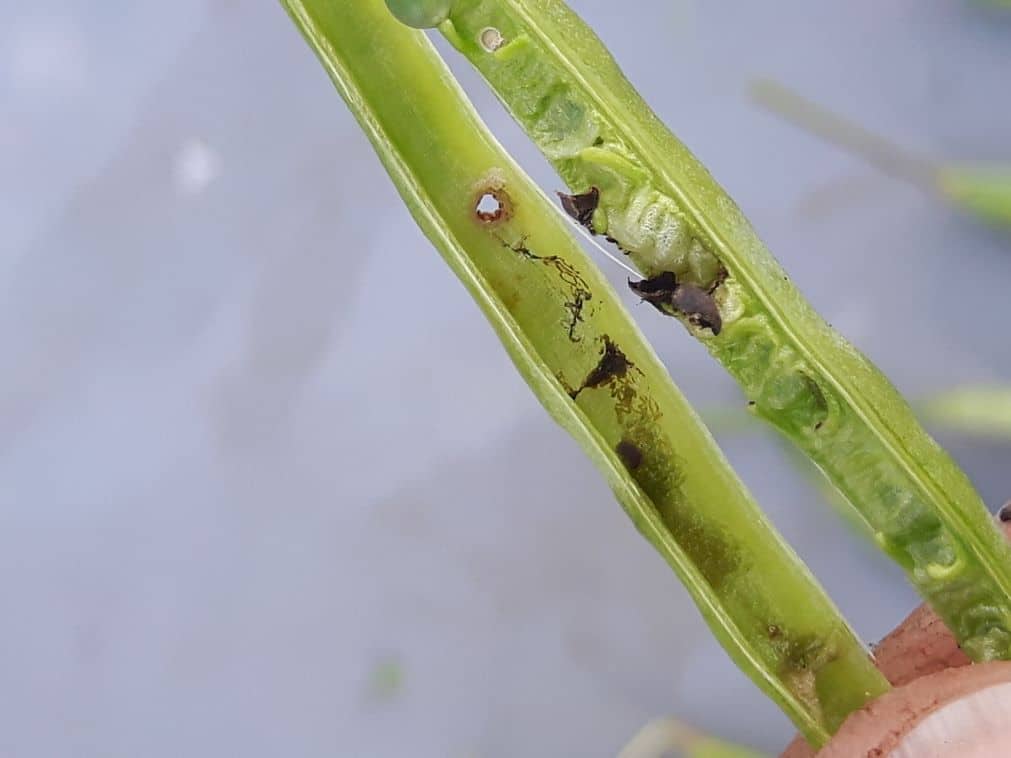
If you are in a field with variable maturity, sweep randomly and don’t just favour flowering patches. You could easily find elevated numbers in the area that has started to flower, but when the field begins flowering more uniformly, the average number of weevils per sweep will decrease.
Note the possible weather effect: On days above 12°C with low to moderate wind, weevils will be concentrated in the top area of the crop. In these conditions, they are easy to pick up with a sweep net.
When to spray
Avoid spraying too soon. CSPW will continue to move into fields as they come into flower, especially first-flowering fields in an area. Egg laying begins when the first pods reach 1″ in length.
The goal is to stop adults from laying eggs in these newly formed pods. First pods reach 3/4″ to 1″ long about five days after first flower. This is around 10-20% flower. A few eggs laid in the first pods is better than spraying too early and not getting good control of higher CSPW populations that may move in.
Avoid peak sun. When you spray an insecticide, avoid peak sunshine hours of the day when bees and other beneficials will be most active in the field. Note that some of the common CSPW registered products are synthetic pyrethroids that can lose efficacy at higher temps. This is another reason to spray later in the day.
Earliest flowers attract more weevils
Earliest-flowering crops often attract more CSPW. Watch them closely. With enough adults feeding, it is possible to have the crop set back at the bud stage – especially a crop under stress or with plant counts below 5 per square foot.
Set a trap. Because adult weevils are decent fliers and will move into the earliest-flowering crops, trap cropping can be an effective practice. For the trap, plant headlands earlier (or to an earlier-flowering cultivar) so they flower five to seven days before the rest of the crop. These traps attract many of the weevils, making them vulnerable to a targeted spray in the trap area only. Despite proven effectiveness in scientific studies, trap cropping is not a common practice.
Other considerations
Tank mixing insecticide with fungicide. The spray timing for cabbage seedpod weevil – 10-20% flower – overlaps with the spray timing for sclerotinia stem rot – 20-50% flower.
If canola canopy humidity has been high in the weeks leading up to flowering and if yield outlook is average or better, a fungicide spray at 20% flower may be warranted.
At the same time, if cabbage seedpod weevil populations are at or above the 25 to 40 weevils per 10 sweeps threshold, a spray at 20% flower is within the appropriate window. In that scenario, a tank mix can be an economical option.
John Gavloski, entomologist with Manitoba Agriculture, notes that automatically tank mixing fungicide with an insecticide ‘just in case’ can reduce predator and parasitoid populations. The broad spectrum sprays go on at flowering when bees and other pollinators are most active. If spraying is necessary, try to spray in the evening when pollinators are less active.
Estimating winter survival. Cabbage seedpod weevils overwinter as adults. A cold winter with minimal snow cover will cause considerable winter kill. “They are not that cold hardy,” Carcamo says. “Minus 7°C will start to cause mortality, but they can survive quite well under a blanket of snow.” Note that one adult can lay an estimated 300 eggs, one per pod. So even with high percentage of winter kill, populations the following year could still be high.
The seed production exception. Commercial seed producers may want to spray cabbage seedpod weevil at the bud stage. This is not ideal, but they don’t want to spray flowering crop because they’ve paid a lot of money for pollinating bees and they don’t want to jeopardize this investment.
CSPW and lygus. According to recent research by AAFC in Alberta, CSPW and lygus do not become pests in the same fields. Early planted fields with high CSPW have very low lygus populations. Thus, there is no economic return to spray for lygus at early flower in early seeded fields.
More…
- Alberta Insect Pest Monitoring Network includes a form to report weevils here. See the real-time map showing count results.
- Prairie Pest Monitoring Network’s annual Prairie-wide survey results and historical maps and CSPW info
- What does 10%, 20% and 50% flower look like?
- The Cabbage seedpod weevil chapter in the Canola Encyclopedia