Canola producers can lose a lot of crop when combine setting are wrong for the conditions. Here are tips to measure combine loss and adjust the combine to limit those losses. This short video has similar instructions.
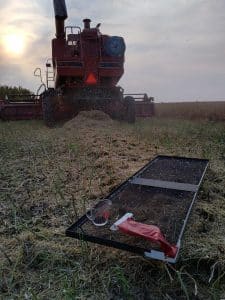
Step 1. Measure losses
Electronic loss monitors will not accurately measure losses until they are calibrated (through the drop pan method described in this article). Measuring true losses out the back of the combine requires a drop pan.
Drop pan options:
- Option 1. Full-width pans that attach under the belly of the combine. This is likely most accurate and safest option, and the combine operator can perform checks on their own.
- Option 2. A pan mounted on a stick. Operaters can target a specific source of loss (right or left side, off the chaffer or off the rotor). When using the stick pan, move it into position upside down so it doesn’t gather any losses ahead of time. To position the pan, walk behind and to the side of the rear wheels and extend the pan to the front of the chaff and straw discharge area. Once the pan is in position, quickly flip it over and stand still until the combine has passed over the pan.
- Option 3. A “throw pan.” Operators throw the pan in front of the rear wheels to land in the discharge area. This method is the hardest to control, with the potential for running the pan over, not having it land in the appropriate spot, or tipping over in the stubble. Beyond that, there are serious safety issues with such a method.
Measure pan square footage to perform the loss calculations below.
To take a sample…
1. Disengage the spreading mechanism and move it out of the way. That way, all straw and chaff drop on the pan. This is important for accurate calculations. (The Harvest Loss Calculator will calculate based on full discharge width if the spreading mechanism is engaged.)
2. Drop the pan, throw the pan or hold the pan.
3. Remove straw and chaff from the sample and preserve only the seed. You can do this by hand, but a screen and sieve work best.
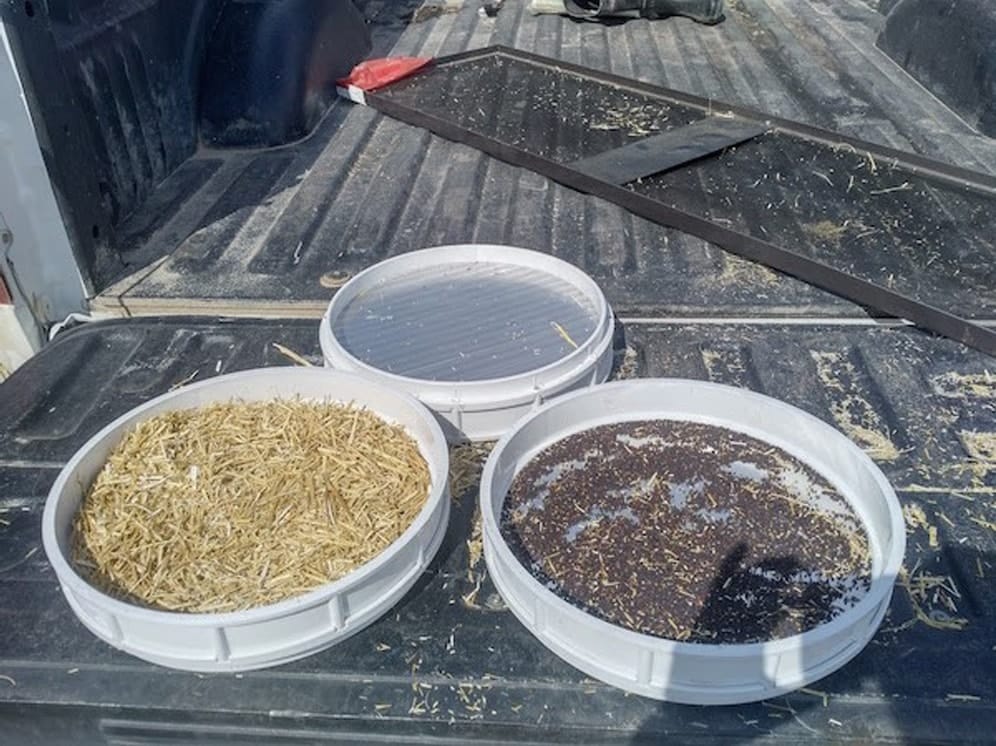
To calculate loss per acre…
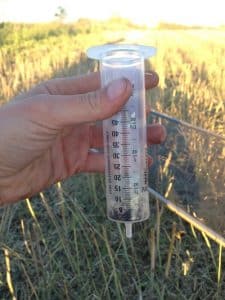
1. Measure the seed in the pan, using weight or volume. The weight method is more precise but it means having an accurate scale handy.
2. Enter all relevant numbers into the Harvest Loss Calculator.
3. Take another sample to increase confidence in the results.
Step 2. Determine whether those losses are acceptable
A one per cent loss is about the best you can expect. Combines running efficiently will lose some grain. If the target is zero losses, the combine may be running too slow to harvest in a timely fashion.
Step 3. If losses are too high, take steps to lower them
The Combine Optimization Tool walks the user through a step by step process to diagnose combine issues. This video explains how to use the tool.
Check for leaks
Losses do not always come out the back end. Before making any adjustment to cylinder speed, concave spacing, fan speed or sieve spacing, look for holes and cracks on the pickup, feederhouse, elevator, shoe seals, separator covers and the grain tank.
Feed the combine properly
Rotaries work best with a narrow windrow. Conventional walker combines work best with a wider swath that creates an even mat over the full width of the cylinder and walkers. In PAMI research conducted by Les Hill, where an even mat resulted in losses of 2.2 per cent, losses rose to 7.5 per cent when the bulk was concentrated down the middle and 12.3 per cent when the bulk was on one side. The reason is that air can’t move through the concentrated mass.
Slow down
It may take just a small decrease in speed – say 0.2 or 0.3 mph – to provide a significant reduction in losses. The loss curve tends to remain fairly flat until ground speed reaches a critical point when combine capacity is taxed. At this point, the loss curve can rise steeply. “When a combine hits that wall, a lot of the time it’ll start dumping grain out the back,” Hill says.
Adjust combine settings
Start with the manual’s suggested settings and go from there. Change only one variable at a time and check losses in between so you can be sure what has either helped or hindered the loss situation.
When considering adjustments, here are a few specific situations and possible solutions:
- If you find unthreshed pods in the chaff, the combine is underthreshing. Increase cylinder or rotor speed, narrow the concave setting, add concave blanks, or slow down.
- Losses can also result from overthreshing, or going TOO slow. If straw is getting pulverized into small pieces that drop down to the sieves, thus reducing air flow and separation, this is usually a result of overthreshing. Cracked seed is another sign of overthreshing. Consider lowering the cylinder speed,widening the concave setting or switching to less aggressive concave sections. This adjustment may also make it possible to drive faster and keep losses constant.
- For more of these scenarios, please read the Combine Seed Loss Guide Combine Seed Loss Guide and try the Combine Optimization Tool.
More…
- The Combine Optimization Tool at canolacalculator.ca can guide you through settings adjustments.
- Harvest loss section of the Canola Encyclopedia
- PAMI study measures actual combine loss
- Timely harvest topics: Wind, dockage and more
- “Losses can be ‘That bad!'” – Article from Canola Digest September 2019
- Limit loss – results from a 2009-2013 study
- Measuring harvest loss – Common questions
- Top 10 harvest questions, including “How can I harvest sooner?”