New canola pests can arrive on the Canadian Prairies, and familiar pests can change their behaviour, spread into new areas or become harder to control. Early detection gives researchers, crop protection companies, extension staff and farmers more time to confirm the pest, assess the risk and develop practical management options.
Key takeaways
- Report unfamiliar insects, unusual pest behaviour or unexplained plant damage early.
- Include the location, date, host crop, clear photos and, when possible, an insect sample.
- Pollen beetle and brown marmorated stink bug are listed by the Canadian Food Inspection Agency as priority pest insects to report in Manitoba, Saskatchewan and Alberta.
- Some pests listed here are already present in Eastern Canada, Europe or nearby U.S. regions and could become a concern if introduced to the Prairies.
- Early reporting helps protect prairie canola production before a pest becomes established.
What should growers and agronomists report?
Report anything that looks unfamiliar, unusual or difficult to explain in a canola field. This includes:
- an insect you do not recognize
- strange behaviour from a familiar pest
- plant damage that does not match common canola pest symptoms
- damage that appears in an unusual pattern, timing or location
Early reports help specialists confirm whether the issue is a known pest, a new pest, a misidentified insect or a pest with a change in behaviour.
Who should you contact if you find a suspicious insect?
If you see an unfamiliar insect or unusual plant damage, contact your provincial insect specialist or the Prairie Pest Monitoring Network.
- Prairie Pest Monitoring Network
- Manitoba: John Gavloski, john.gavloski@gov.mb.ca
- Saskatchewan: James Tansey, james.tansey@gov.sk.ca
- Alberta: Amanda Jorgensen, amanda.Jorgensen@gov.ab.ca
What information should you provide?
Provide enough detail for specialists to understand where the insect was found, what crop it was on and what damage was visible.
Include:
- notes on location, date and host crop
- photos from several angles
- a sample of the insect, when possible
Insects are often small, and closely related species can have small markings or body features that are difficult to confirm from a photo. If you can collect a specimen, freeze it and contact the specialist for next steps.
The Canadian Food Inspection Agency has a list of “Priority Pest Insects to Report” for Manitoba, Saskatchewan and Alberta. Two pests in this article are on that list: pollen beetle and brown marmorated stink bug. View the “Priority Pest Insects to Report” for Manitoba PDF.
Brassica pests to watch for
The brassica-crop pests below are not established on the Canadian Prairies, but might thrive if introduced. They are worth watching for because they affect canola, rapeseed or other brassica crops in other regions.
Pollen beetle
Other common name: Bronzed blossom beetle
Latin name: Brassicogethes viridescens
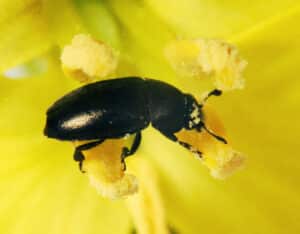
Pollen beetle is a high-risk pest to watch for because it feeds on canola buds and flowers and can reduce pod formation. It is already present in Eastern Canada and could be well adapted to the Canadian Prairies if introduced.
What does pollen beetle look like?
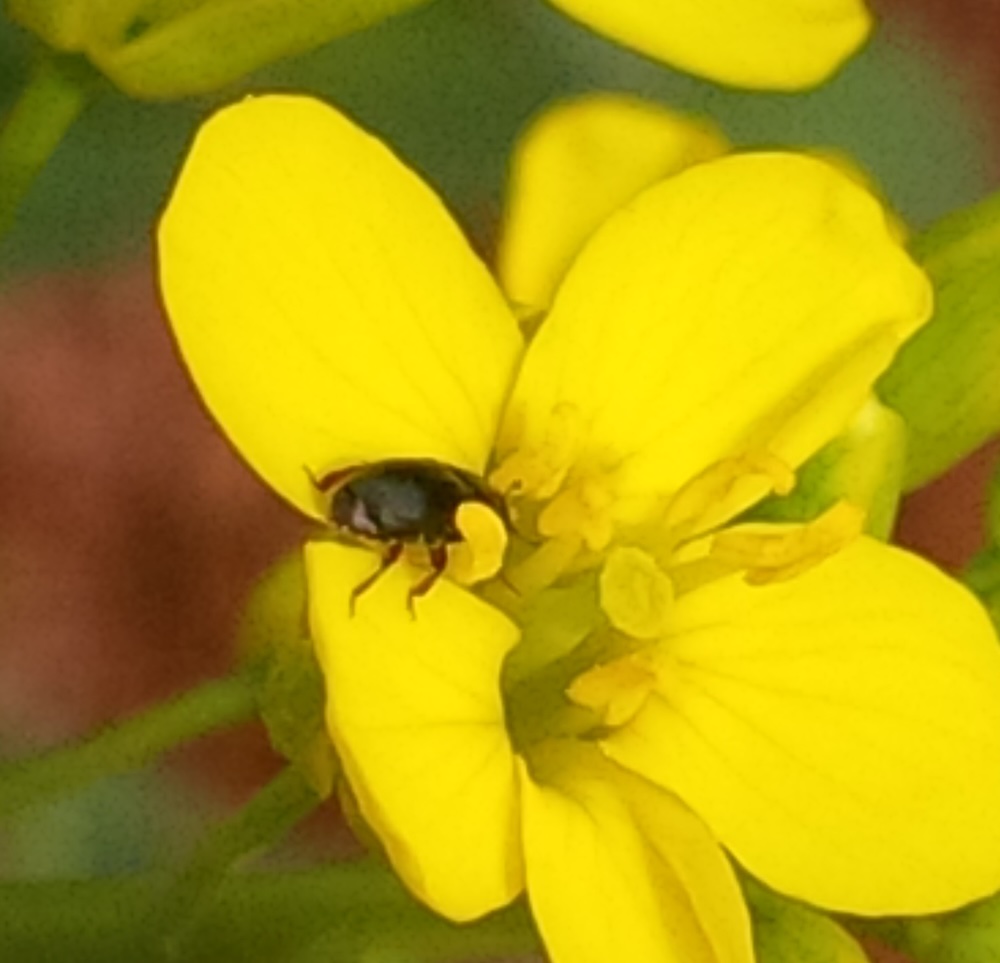
Adults look somewhat like flea beetles, but they do not jump and their antennae are clubbed at the tip.
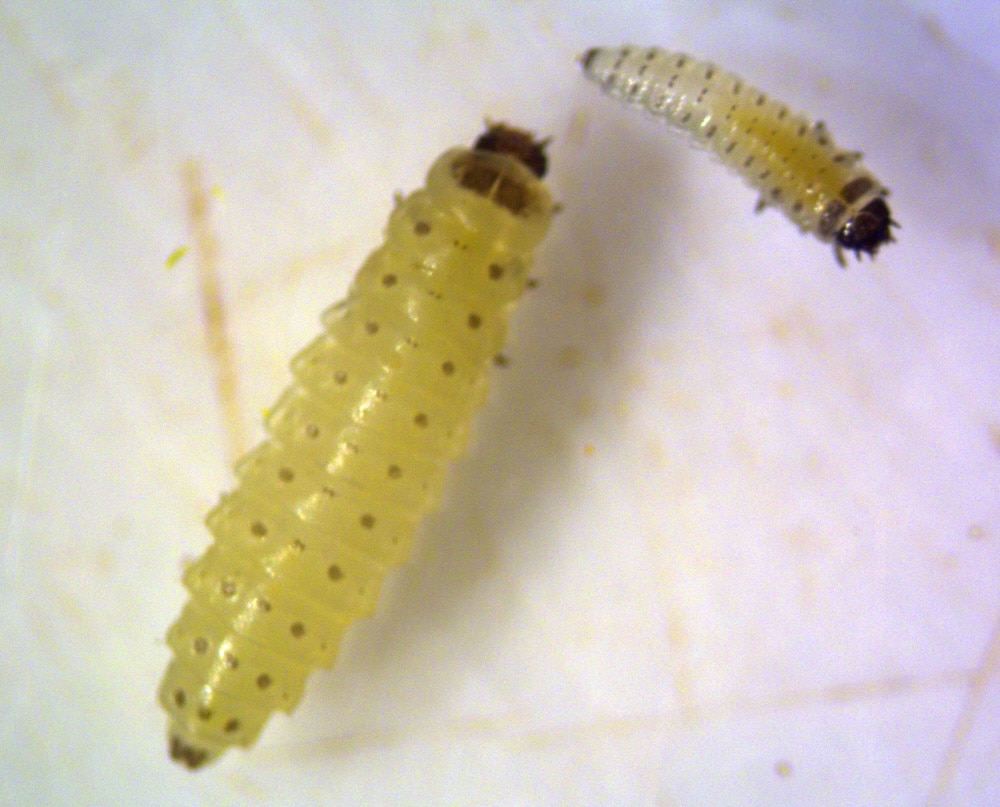
Larvae are tiny, whitish green with dark dots and a black head.
- First instar larvae are found inside buds and are about 1.0 to 1.5 millimetres long.
- Second instar larvae are about 3 millimetres long and are found in flowers.
- Look on and inside buds and flowers for adults and larvae.
What damage does pollen beetle cause?
Pollen beetle can cause:
- chewed buds
- missing pods
- empty pods
- reduced flower fertilization
- pod abortion from adult and larval feeding
Where is pollen beetle currently found?
Europe has two species: B. viridescens and B. aeneus. Eastern Canada, including Atlantic Canada and Quebec, has one species: B. viridescens.
Adaptation to the Canadian Prairies: Could be well adapted. Pollen beetle is managed with insecticide sprays in Europe.
Prairie risk level: High
Links
Swede midge
Latin name: Contarinia nasturtii
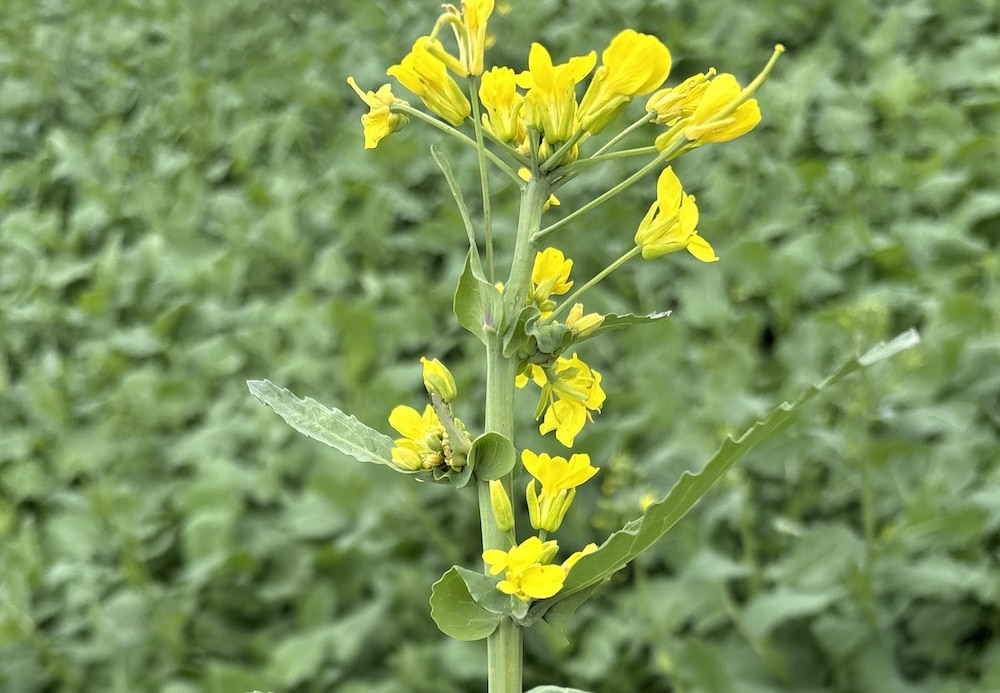
Swede midge is a high-risk pest because its larvae feed inside the growing point of brassica plants and can cause serious yield loss. It has been very damaging to canola in parts of Ontario and could thrive in wetter, warmer parts of the Prairies if introduced.
What does swede midge look like?
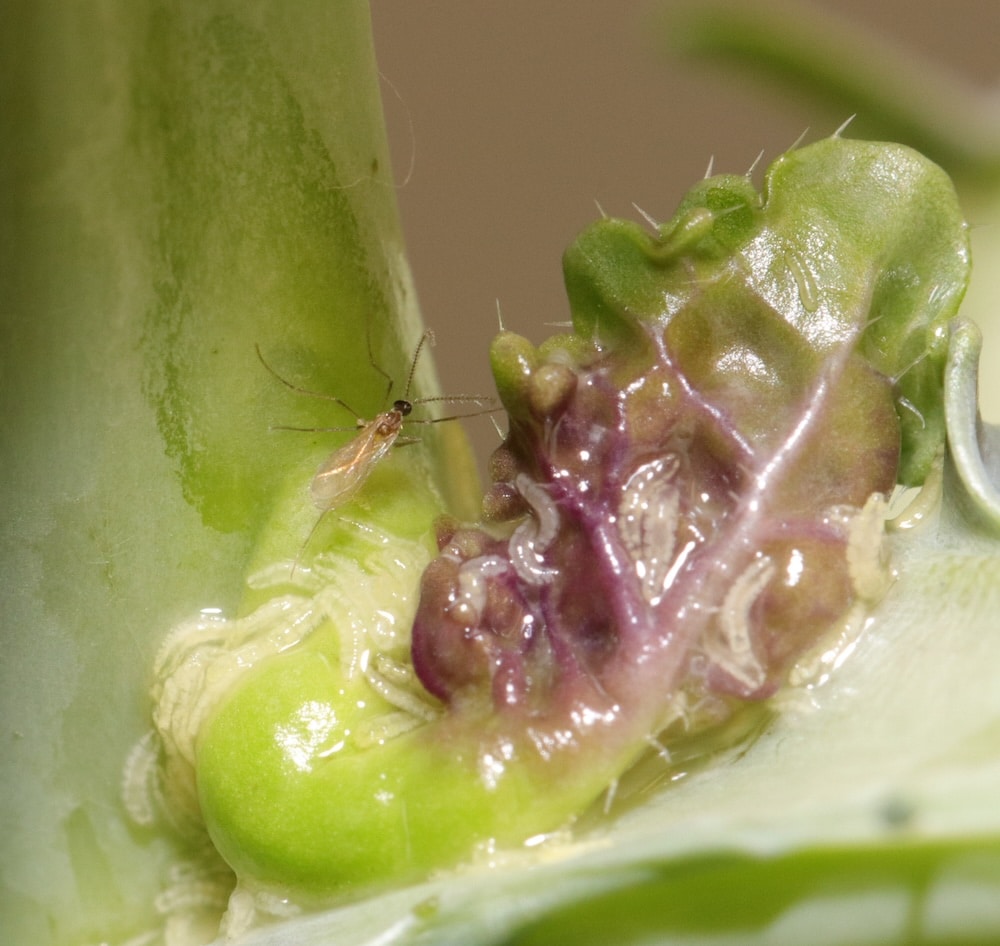
The adult swede midge is a tiny brown fly. It looks similar to closely related midges, including canola flower midge (Contarinia brassicola), which was officially identified on the Prairies in 2019.
The larvae are whitish yellow maggots up to 3 millimetres long.
What damage does swede midge cause?
Swede midge larvae feed within the growing point. Enzymes from their saliva interfere with normal plant growth.
Look for:
- stunted plants
- deformed growing points
- flowers and pods in clusters
- flowers and pods appearing from unusual places on stems
Where is swede midge currently found?
Swede midge is found in Europe, Ontario and Minnesota.
Swede midge has caused significant canola damage in some areas of Ontario, especially the spring canola region of Temiskaming. Insecticides are only moderately effective, and growers often rely on crop rotation and multiple sprays because the midge arrives in waves.
Prairie risk level: High
Adaptation to the Canadian Prairies: Could thrive if introduced in areas with more moisture and heat
Links
- Find more on swede midge and canola flower midge in the Insect section at canolaencyclopedia.ca.
- Ontario swede midge information sheet
- Ontario swede midge best management practices
Stem weevil
Latin name: Ceutorhynchus napi and others
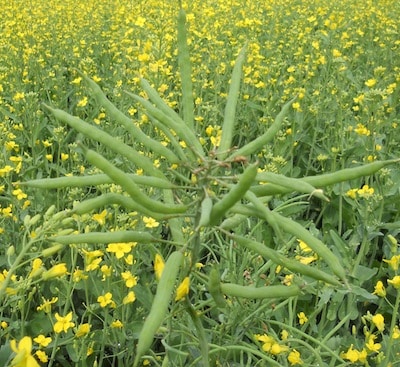
Stem weevil is a low- to moderate-risk pest to watch for because some species can damage stems and affect plant survival. A related species, cabbage seedpod weevil, is already common in Western Canada, which suggests other weevil species could adapt if introduced.
What does stem weevil look like?
Stem weevils resemble cabbage seedpod weevil, Ceutorhynchus obstrictus (Marsham), which is common in Western Canada.
What damage does stem weevil cause?
Adults chew leaves and stems and lay eggs in the holes. Larvae tunnel through leaves and stems. With enough stem damage, the plant may die.
Where is stem weevil currently found?
Ceutorhynchus napi is active in spring in Europe and causes more damage than other stem weevil species. It appears to be increasing in Europe for reasons that may include lower plant stands, climate shifts and the loss of neonicotinoid seed treatments.
Prairie risk level: Low to moderate
Adaptation to the Canadian Prairies: Could adapt well if introduced
Links
- AHDB biology of cabbage stem weevil
- Bayer cabbage stem weevil information
- AHDB management of rape winter stem weevil
Cabbage stem flea beetle
Latin name: Psylliodes chrysocephala
Cabbage stem flea beetle is considered a low risk for Canadian spring canola, but it is included here because it is a major pest of winter oilseed rape in Europe.
What does cabbage stem flea beetle look like?
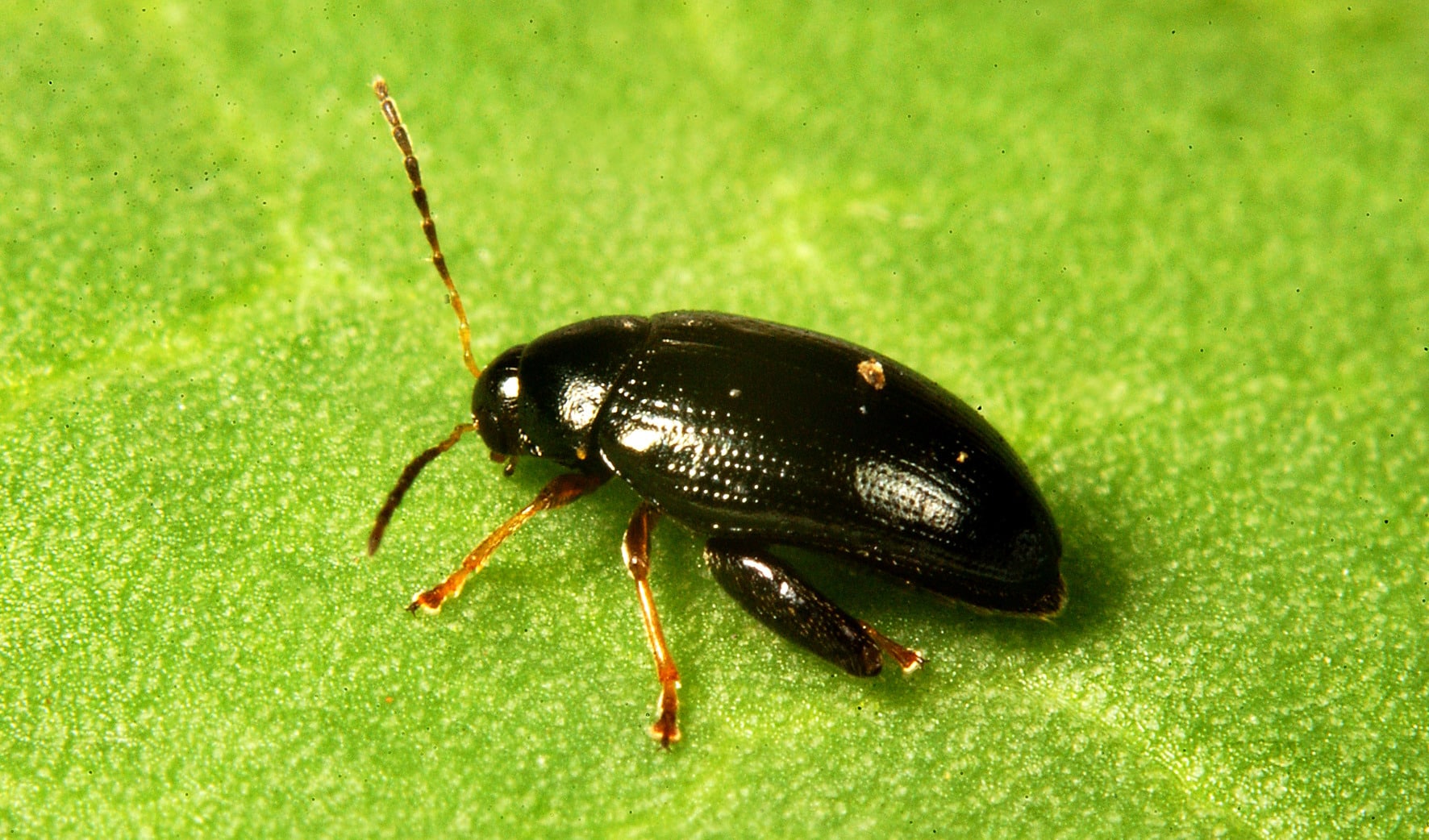
Cabbage stem flea beetle looks like a flea beetle.
What damage does cabbage stem flea beetle cause?
Adults feed in a similar way to flea beetles already found in Canada. The greater damage comes from the larvae.
Adult stem flea beetles lay eggs in young plants. Larvae hatch and feed inside stems and growing points. This feeding can stunt growth and kill plants.
Could cabbage stem flea beetle adapt to the Prairies?
Cabbage stem flea beetle is a winter canola pest based on its life cycle. It lays eggs in the fall into winter canola, so it is less likely to adapt to Canadian spring canola production.
Even though the risk is considered low for Canadian spring canola, Psylliodes chrysocephala is included because it is described as “the major pest” of winter oilseed rape in Europe in the 2024 article “Biology, Ecology, and Management of Flea Beetles in Brassica Crops” in Annual Review of Entomology
Prairie risk level: Low
Adaptation to the Canadian Prairies: Likely low for spring canola
Links
Other flea beetles
Flea beetles are already familiar pests in prairie canola, but other flea beetle species could become more relevant as pest pressure, climate and control options change.
There are 300 Phyllotreta flea beetle species alone. Sweden has four common flea beetle species in rapeseed, including one species also found in Canada: Phyllotreta striolata, striped flea beetle.
Phyllotreta atra, which is not a pest in Canada, has become more common in Sweden, possibly because of climate change.
Chaetocnema is another flea beetle species common in Sweden.
What do other flea beetles look like?
They look like flea beetles.
What damage do other flea beetles cause?
Flea beetles chew on:
- cotyledons
- leaves
- stems
Where are other flea beetles currently found?
Flea beetles are found on brassica crops around the world.
Prairie risk level: Not more than the current flea beetle risk
Adaptation to the Canadian Prairies: High
Most flea beetle-type pests are an increased concern in Europe because of the loss of neonicotinoid seed treatments. Some growers in Sweden have other options, including Buteo and Lumiderm.
Brown marmorated stink bug
Latin name: Halyomorpha halys
Brown marmorated stink bug is a moderate-risk pest to watch for because it feeds on many host plants and is already established in parts of Eastern North America. It is on the CFIA priority pest insect list for the Prairie region.
What does brown marmorated stink bug look like?
Adults are square-shaped brown bugs about 1 centimetre across. They are somewhat similar to a large lygus bug and have a back that looks like a Viking’s shield.
Each instar looks somewhat different from the one before.
What damage does brown marmorated stink bug cause?
Brown marmorated stink bug feeds on a wide range of plants and has more than 100 host plants in North America.
It does most of its damage to:
- fruits
- buds
- pods
Where is brown marmorated stink bug currently found?
Brown marmorated stink bug is native to northeast Asia, including China and Japan. It is now moving around the world and is well established in the eastern United States and southern Ontario.
Prairie risk level: Moderate
Adaptation to the Canadian Prairies: Moderate
Brown marmorated stink bug has not established on the Prairies, as far as currently known, but it is an insect to watch for. It is listed by the CFIA as a priority pest insect to report in the Prairie region, along with pollen beetle.
Links
Aphids
Aphids are not new to the Prairies, and they rarely reach economic levels in prairie canola. They are included here because aphids are major pests of brassica crops in other regions and should be recognized and monitored.
Several aphid species can affect brassica crops, including:
- cabbage aphid, Brevicoryne brassicae L.
- turnip aphid, Lipaphis erysimi Kaltenbach
- peach aphid, Myzus persicae
- potato aphid, Macrosiphum euphorbiae
What do aphids look like?
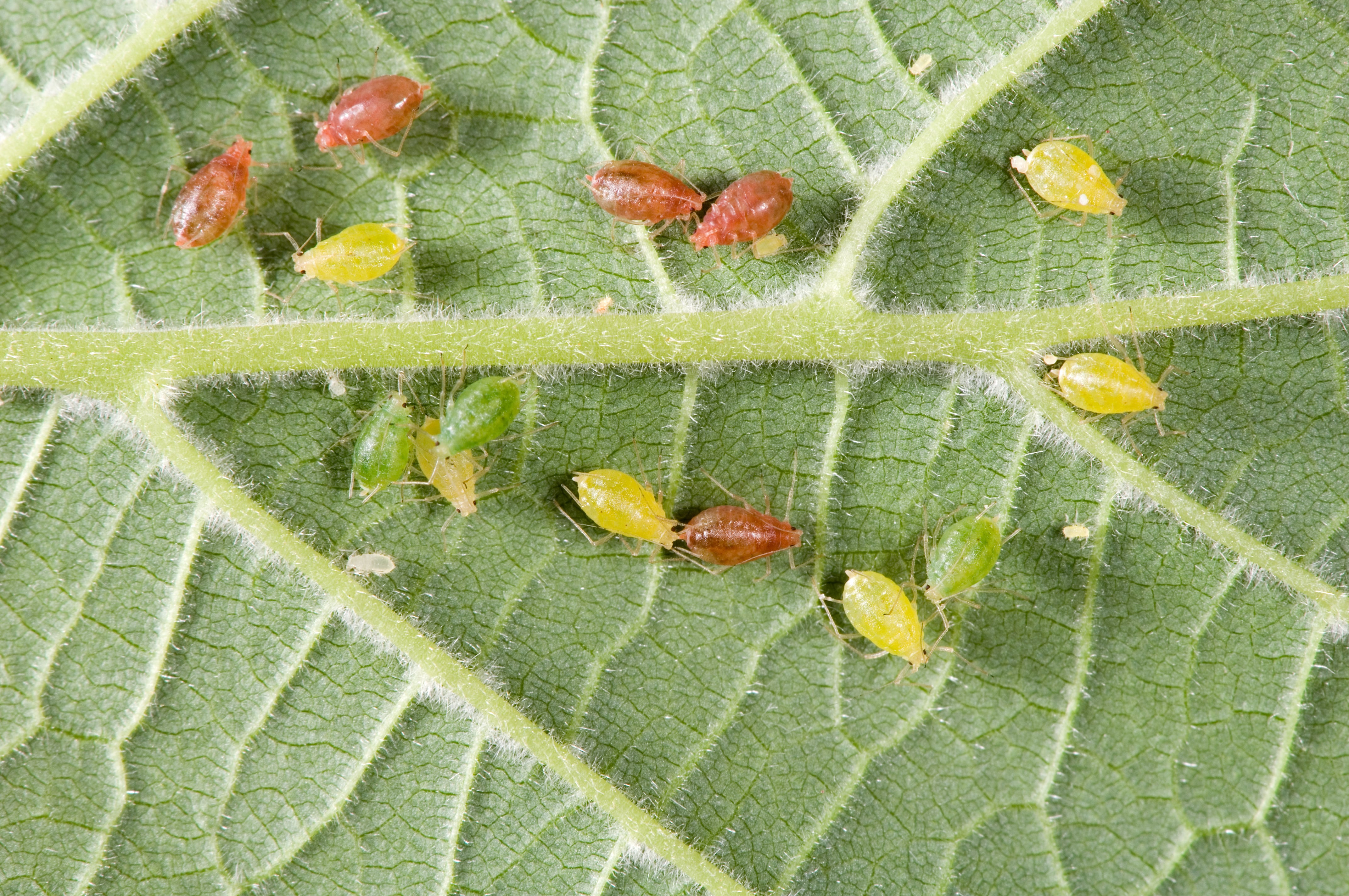
Aphids are soft green insects, about 1 to 3 millimetres long, usually found in large clusters. They can be confused with lygus nymphs, but intense clustering is more typical of aphids.
What damage do aphids cause?
Aphids suck moisture from stems. Aphid honeydew can also attract moulds, and some aphids can carry plant viruses.
Where are aphids currently found?
Aphids are found almost everywhere. They are major pests of canola, rapeseed and other brassica crops in Europe, India, Australia, California and other regions.
They appear in Canadian canola, but so far have generally stayed below economic levels.
Prairie risk level: Moderate
Adaptation to the Canadian Prairies: Potentially increasing
Western Canadian aphids may be an extra week or two of warm weather away from larger outbreaks. Aphids can have up to 15 generations per year and can reproduce without mating.
Insecticides can control aphids, although pyrethroid-resistant aphids have been reported in France.
Related Canola Watch resources
These Canola Watch resources can help growers and agronomists report, photograph and diagnose unfamiliar field issues: