With many growers upping their canola acres, canola is often going on fields that were not planned for canola when growers were doing their herbicide applications last year. Check herbicide records to see if the field had a group-2 product last year, particularly a known residual product such as imazethapyr found in Odyssey and other products. Growers need to check …
Calibrate the drill between crops and seed lots
Canola can reach its yield potential with a stand of 7 to 14 plants per square foot. To hit that target, growers may need a different pound-per-acre seeding rate for each seed lot. That’s because canola seed can range in size from 3 grams or less per 1,000 seeds all the way to 6 grams or more per 1,000. To …
Seed a few strips 1 MPH slower
We understand that in the spring rush, seeding slower doesn’t make sense to many growers. So for growers not prepared to slow down for the whole farm, we encourage them to try a few strips at a slower speed. Mark off these strips and keep that speed difference in mind when doing stand establishment scouting and when reading the combine …
Clubroot management starts with clean tools
Clubroot-resistant varieties came to market for this year, providing growers another tool against the disease. But cleaning dirt from tillage and seeding equipment is still the first line of defense against the spread of clubroot. These tools are the primary carriers of infection. At a minimum, growers should knock off soil lumps and loose soil from any machine before it …
Be export ready: Don’t seed these varieties
Canada has a reputation for producing safe, high quality canola — a reputation that is well deserved. Most importing countries will not accept canola shipments containing de-registered varieties, so don’t grow the following varieties: Hysyn 101RR, 295BX, Cartier BX, Zodiac BX, Renegade BX, Exceed, 2631 LL, Swallow, SW Legion LL, SW Flare LL, LBD 2393 LL, Innovator, Independence, HCN 14, …
Tempted to seed early? Think frost
Warm soil temperatures and decent soil moisture in most regions will mean rapid emergence. Seed put in the ground today could be up in seven to 10 days. (The graph below shows the connection between soil temperature and faster more even emergence.) Frost damage risk for these early crops is higher, especially if the plants have not been hardened off …
Fertilize to make optimal use of moisture
With the rains last week, many regions have good topsoil moisture plus three to four feet of subsurface moisture. That means crop nutrients, not moisture, could be the limiting factor for yield. With fertilizer prices back in line this year, fertilizing to match yield potential can be an effective way to maximize profitability. Applying all fertilizer at the time of …
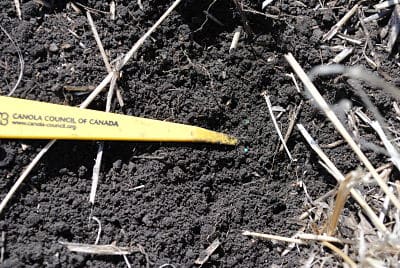
How to check seed depth
Step 1. Start 100 feet or more behind where you stopped the seeder or walk over to the previously seeded pass. You want to check seed depth where the drill would have been moving at full speed. That way the seed measurement will accurately reflect what the drill is doing. Step 2. Use a seed depth tool (shown in the …
Rotations tighten, disease risk rises
While the recommended rotation for disease management is to seed canola once every four years, more growers are using a three-year or two-year rotation. This year we’ve heard more talk of canola on canola. This can cause a rapid build up of disease inoculum in the field, especially for clubroot and blackleg. With tight rotations, canola varieties with resistance to blackleg …
Hot April puts stored canola at risk
Growers need to check their bins and grain-storage bags, even if canola was dry when it went in. With the warmer than usual April, many areas report some level of heating in storage facilities. When spring sunshine warms the outside of the bin, warm air moves up near the outside wall and down through the centre of the grain mass. The cooler canola in …