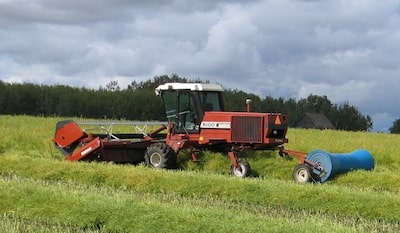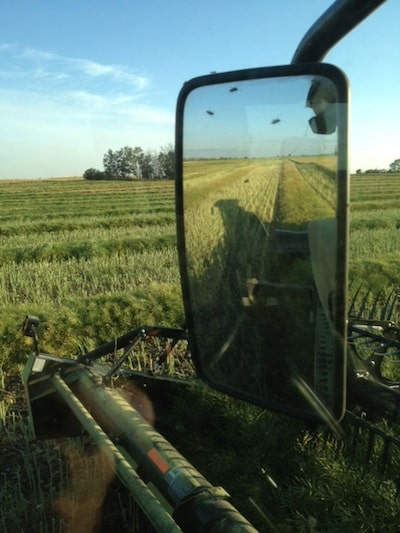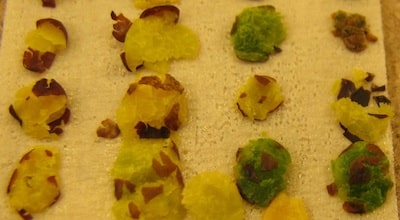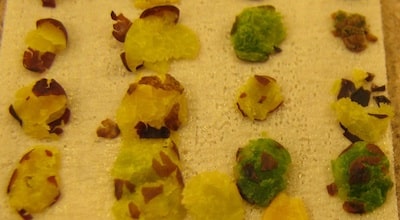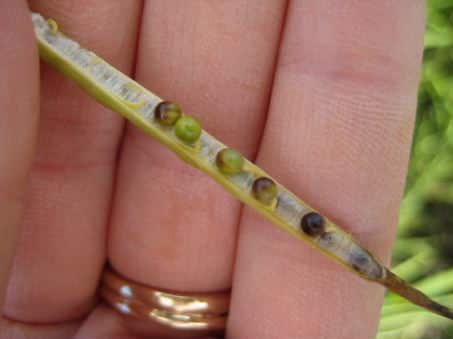
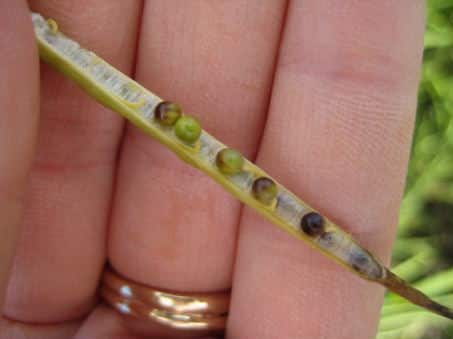
The ideal swath timing is when 60% of seeds on the main stem are showing some colour change from green to brown. Colour change is considered any amount of yellowing or browning on the seed. To determine ideal swath timing, fields need to be walked and pods need to be cracked – it is 60% seed colour change not pod colour change.
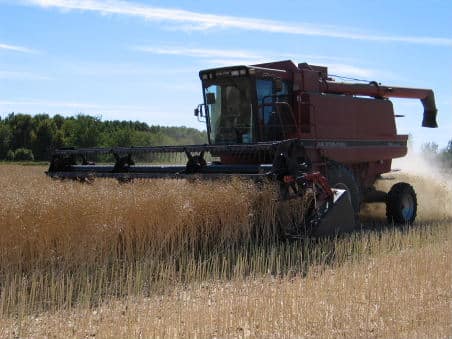
Straight-cut vs swath – tips to help decide
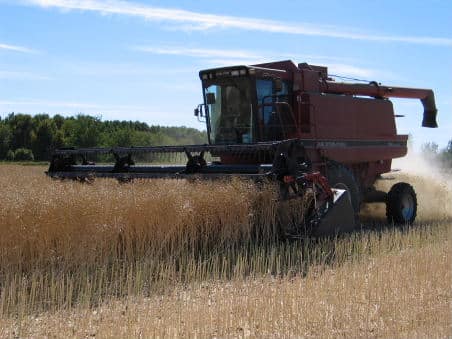
Wet soil conditions in parts of Manitoba have some producers debating straight cutting to allow fields to dry out. Crops that are good candidates for straight cutting are uniform, well knitted and have good standability. A slightly leaning crop can still be good to straight cut. Click here for more information on the risks and rewards of the two different harvesting systems – straight cutting vs. swathing. Click here for a pod cast with Canola Council Agronomist Greg Sekulic about the risks and rewards of straight cutting and how understanding which fields are good candidates is the first step towards success.
Canola School video: Preparing to Straight-Cut, then Swathing Too! Chris Holzapfel discusses an integrated approach to straight cutting canola
Top 10 things to address before you swath
2. At what percent seed colour change (SCC) will you begin swathing? The ideal for yield and quality is 60% seed colour change, but growers with lots of canola to swath will probably have to cut some earlier — especially if late-seeded canola caught up to early-seeded canola and everything seems to be at the same stage.
1. Assess the maturity of all the canola fields on your farm to determine which fields will be ready first. SCC advances by about 10 percentage points every 2 or 3 days.
Read more for the other 8…
Swathing a multi-staged crop
The swath decision becomes more difficult in crops with plants at multiple stages of growth. For example, if some plants are at 60% seed colour change (SCC) on the main stem and other plants are still flowering, growers may want to hold off on swathing. Or if plants are large with many secondary stems, the main stem may be at 60% SCC, but seeds in side branches are still mushy and green. These seeds would wither up and amount to nothing if the crop is swathed at 60% SCC on the main stem. The decision requires an assessment of the field, and a look at the calendar….
Green seed management begins with seeding
Growers can plan at this time of year to make sure they have enough seed purchased to achieve the target plant stand of 7-10 plants per square foot, which will provide a more uniform-maturing stand and a lower green count. Also, take note of the maturity ratings for each variety.
High green? Pros and cons of waiting to combine
Growers with dry canola and high green counts are wondering whether to leave the swathed crop a while longer or combine now and accept the grade loss. When making that decision, ask: Is moisture in the forecast? How green is it? What’s the price discount? These and other considerations will help with the decision.
High green increases storage risk
Canola with high chlorophyll content is less stable in storage, even if the canola is dry and cool. The safest bet is to deliver sooner than later. If that is not an option, proper conditioning and frequent monitoring for heating and spoilage are crucial until it can be delivered.
Frost in forecast: Should you swath now?
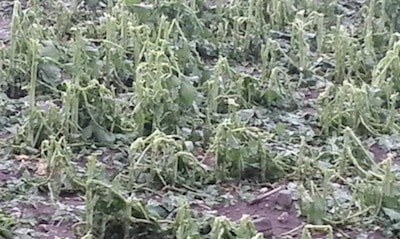
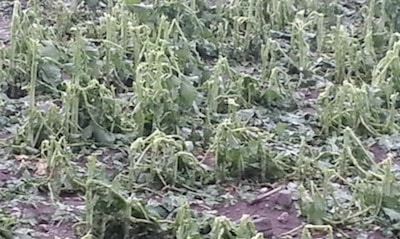
With light frost in the forecast, crop left standing will still have a chance to mature further. A heavy frost will lock in high green counts unless the crop has adequate dry down time to achieve a seed moisture of 20% or less. Swathing has to occur at least 3 good drying days before the frost to achieve this benefit. If the crop is that green, however, growers may want to take the chance on a light frost knowing the crop needs more time to mature.