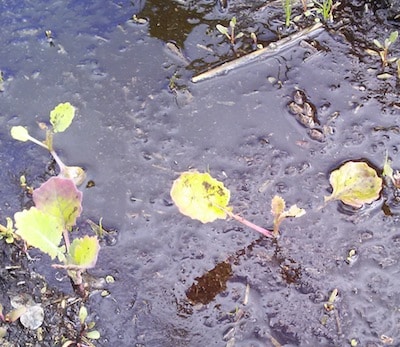
Growers can expect to see some nitrogen loss from extended heavy rains, probably in the range of 20-50%. Before top dressing, wait to see how the crop recovers from saturated soils before investing any more in fertilizer. Don’t do anything while soils are still wet — roots cannot take up nutrient when soils are saturated. Applying nutrient direct to leaves doesn’t help. Most foliar-applied nitrogen is washed off and then goes into the root zone. Uptake through the leaves is minimal.
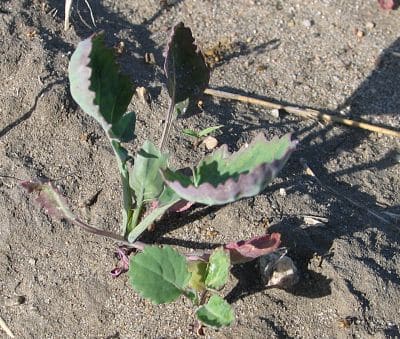
Top dress: Identify N and S deficiency
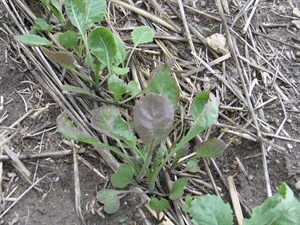
Growers who used elemental sulphur as their only sulphur source may see deficiencies in this year’s crop. Elemental sulphur will not be available when the crop needs it. In following the 4-Rs of fertilizer, elemental sulphur applied at seeding is not the “right source” or the “right time.” Sulphur deficiency symptoms (see the photos) that appear at the bud to bolt stages can be fixed with a top-dress of ammonium sulphate, a highly available source of sulphur.
Rescue treatments for hailed crop
Nutrient and fungicide top dress treatments have been promoted to help heal and restart canola after hail. We don’t have published studies on using these or any treatments for this purpose in Western Canada, so it’s buyer beware. Leave a check strip to see if they improved yield. For products that require foliar uptake to work properly, severe hail damage may have striped the leaves, reducing the surface area available for absorption by the plant.
When does top-dress fertilizer make sense?
Click here for more information on products, rates and timing for best results from a fertilizer top-dress. This article has just been updated.
If you’re on the fence about a top-dress application, consider applying a rate high enough to make a difference — such as 30 pounds of nitrogen or 20 pound of sulphur — to part of a field. Mark the location and compare yields for treated and untreated areas. Increasing greening does not necessarily translate into increased yield, so a simple observation of crop colour is not enough to determine the value of the top dress. If you do see a yield difference, the best solution may be to increase fertilizer rates at seeding.
Equipment for top-dressing fertilizer
Fertilizer dribble options for the sprayer:
1. Streambars or dribble bars are long bars — 12” to 15” or so each — with 4 holes along the length. They attach to each sprayer nozzle point, with the bar designed to reduce the distance between streams. Advantage: Streams drop straight down so spray patterns are unaffected by boom height. Disadvantages: They are more expensive than the second simpler option, and they are more likely to break if the boom hits the ground.
2. Fertilizer nozzle bodies with 3-4 streams fanning out in different directions from a single point. (See the photo at the top.) Advantage: They tend to be cheaper than streambars or dribble bars. Disadvantage: Patterns can overlap more as boom height increases.
Seed-place ammonium phosphate only
The bottom line for seed-placed fertilizer in canola:
1. Apply plant available sources of nutrients.
2. Place a modest rate of P in the seedrow. At rates over 20 lb./ac., the salt component in MAP, for example, can start to set back seedling survival.
3. Place N and S in a band away from the seed.
Buyer beware with novel fertilizer products
If a grower decides to try something new, find a uniform field, try one product at a time and leave an untreated check, ensuring both treated and untreated areas are accurately measured for final yield and grade so a true economic comparison can be made. In reality, some products may provide a good payoff for the price, but that payoff may only materialize one year in 4. A few years of trials may be required to get a true picture of the economics before making a final decision. Check out these strip trial tips for more insights on how to get the best possible information from your own on farm research.
N does bad things when S is missing
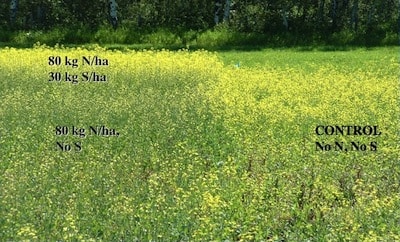
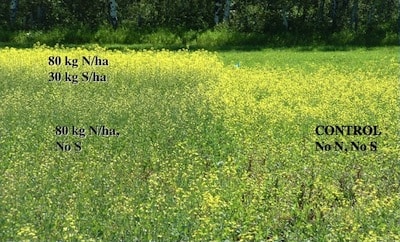
When fields are sulphur deficient, canola that receives only nitrogen fertilizer (front left in photo) can yield less than canola that receives no fertilizer at all (right in photo). Canola plants need sulphur to produce three key amino acids: methionine, cysteine and cystine. Without the S to build these amino acids, N creates toxic amides in the plant that greatly inhibit seed set.
“Hidden hunger” with P deficient soils
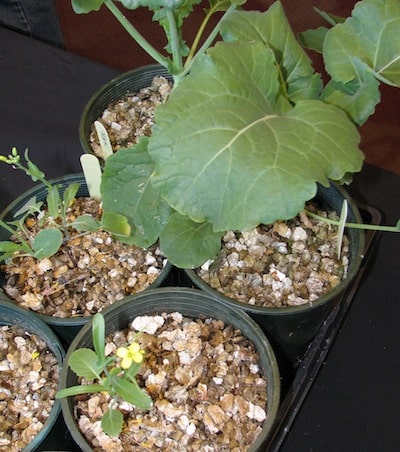
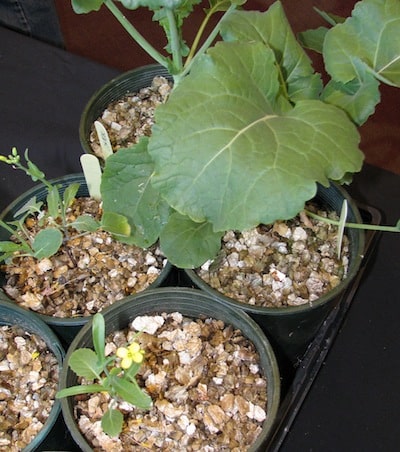
A 50-bushel crop can remove more than 50 pounds of P205 per acre. Growers using only seed-placed phosphate at a rate of 15 pounds per acre can slowly deplete the soil of phosphate. That can start to affect yield potential on the field over time. These plants, demonstrated at CanoLAB, were seeded the same day in a greenhouse and fed hydroponically to demonstrate extreme P deficiency. The potting mix has no nutrient value. The large plant received required levels of P. The tiny plants in front received no P.
How to use the Canola Diagnostic Tool
Give the brand new online Canola Diagnostic Tool a pre-season test drive at www.canoladiagnostictool.ca. Start with a problem scenario that you encountered in a canola field in 2012, and work through the tool to see what potential causes it provides. Read the cause descriptions and “ways to confirm” to determine which cause is most likely.