Missing flowers likely due to early environmental stresses | Sclerotinia risk high | Insect management | Do add-ins add up?
Topics for the Week
Sclerotinia risk is building | Lygus bugs | Grasshoppers | What’s wrong with that crop?
Topics for the Week
Cabbage seedpod weevil | Prioritize predicting sclerotinia | Still planning an in-season herbicide? | How is that crop looking?
Topics for the Week
Protect that (high value) crop from disease | What’s the ROI on that new product? | Top tips to optimize 1-pass herbicide | What if Mother Nature doesn’t play along
Topics for July 7, 2021
Spraying for sclerotinia | Heat damage | Beneficial insects | Late-window herbicide applications
CANOLA QUIZ – Sclerotinia risk for 2021
Four questions to help assess the sclerotinia stem rot risk situation for 2021.
Will hot, dry weather stop sclerotinia stem rot?
Not really. If infection got started, then this fungus is in the plant. When conditions are ideal (relative humidity over 80 per cent and temperatures of 20°C to 25°C) then pathogen grows aggressively eating up more tissue. When conditions are not ideal, the disease slows…waiting, patiently.
Did you use a sclerotinia prediction tool?
CCC agronomy director Clint Jurke is looking for farmers who made the decision to spray or not spray fungicide for sclerotinia based on what a sclerotinia stem rot prediction tool – sclerotinia checklist, spore testing or weather station predictions – told them.
Sclerotinia window and pre-harvest interval

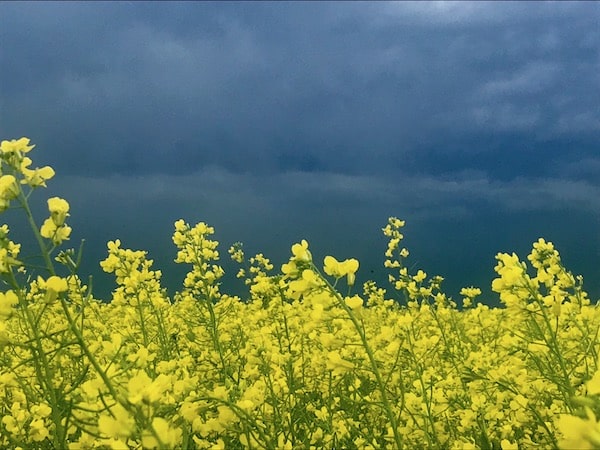
The window for fungicide application closes after 50 per cent flower – which is when the field is at its most yellow. Once this “full bloom” starts to wane, spraying must stop.
Sclerotinia: Does fungicide at 50% flower make sense?

In general, late applications are not as effective as applications at 20 per cent flower because early infection tends to cause the most yield loss. But fungicide applied late in the window can provide valuable protection from sclerotinia stem rot if flowering is extended or if conditions become more conducive to disease.