Sclerotia depots: A new early warning system

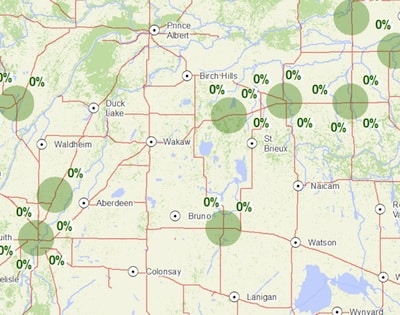
Scientists at Agriculture and Agri-Food Canada are testing an early warning system for sclerotinia in canola. The project is in its first year and involves 35 volunteers in Saskatchewan monitoring the emergence of apothecia in 67 sclerotia depots across the province. Each depot consists of 50 sclerotia (fungal resting bodies) buried at the soil surface. Sclerotia in the depots are expected to germinate at a similar rate as the thousands of sclerotia naturally occurring in the soil (as a result of past sclerotinia white mould incidence). The volunteers report percent sclerotia germination two to three times per week when the canola is flowering. Sclerotia germination data from all depots are available on SaskCanola’s website (www.saskcanola.com). Click on the “Percent sclerotia germination map” icon. The provincial map can be moved in all directions and zoomed in or out.
Trying a new treatment? Leave a test strip

Want to see how a foliar nutrient application helps a hailed crop? Leave a check strip. Want to see whether a novel treatment provided a return on investment? Leave a check strip.

Growers can use strip trials on their own farms to test how a particular practice or product performs in a local environment. This information can then be used to help decide whether it may be worthwhile to try this new practice or product on a larger proportion of the farm, and to target it at acres with the greatest likelihood of success.

Different clubroot pathotype confirmed

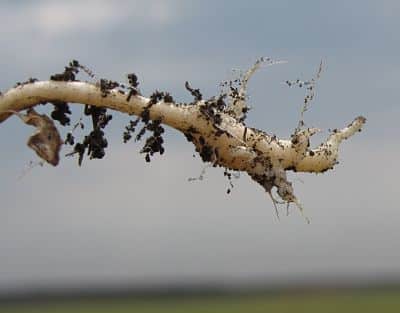
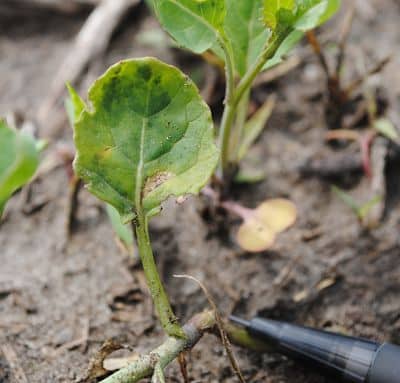
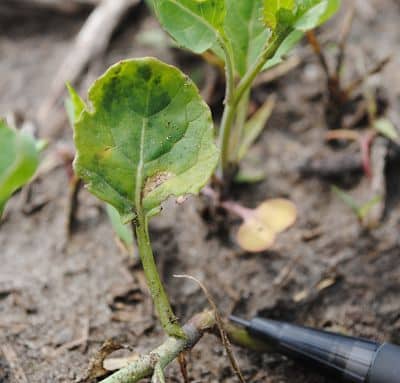
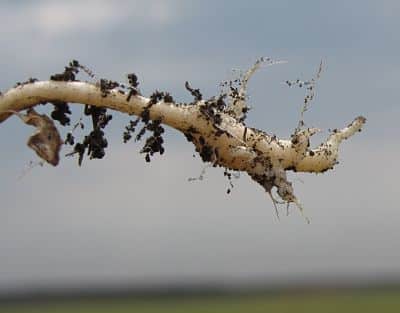
Canola with small developing clubroot galls. Source: Stephen Strelkov

Research has confirmed the presence of a different clubroot pathotype in the Edmonton region and none of the commercially available clubroot resistant varieties in Western Canada are effective at managing it.

Stephen Strelkov, the University of Alberta researcher leading this project, has identified other resistance genes that could work, but they are not currently in commercial hybrids.

Clubroot and mud

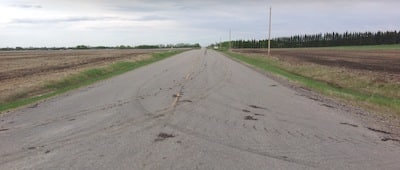
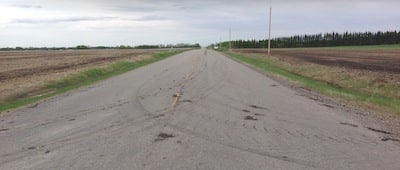
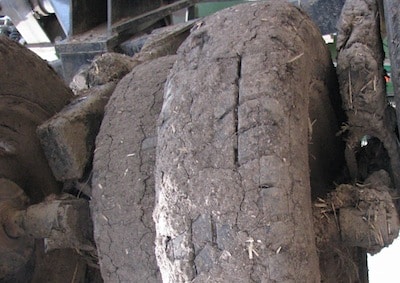
A moist late spring means more mud clinging to equipment and, because growers are under extra pressure to get the crop seeded, less time available to clean equipment between fields. This greatly increases the risk of clubroot spreading from field to field. The following photos show high risk scenarios for clubroot spread…

mud on highway clubroot
Mud on packers

Improve pesticide ROI

Blackleg lesions on young plants are more likely to cause significant yield loss than infection later in the season, but the economic return on early season fungicide is often not there.

Growers face many weed, insect and disease management decisions throughout a growing season. In many cases, these applications provide a clear return on investment. In other cases, they do not. Here are a few examples where applications have a very low chance of providing a return.

Knock off clubrooty mud

Moist seed conditions mean more soil clinging to drills and tractor and sprayer wheels. This increases the risk of moving clubroot as well as weed seeds and insect pupae around the farm. With the discovery of a potential new clubroot pathotype, growers will want to take time to sanitize equipment between fields.

ALERT – Possible new virulent clubroot pathotype

Look out for clubroot patches in 2014 — even if the field is seeded to a resistant variety.

New data from the Alberta clubroot disease survey indicates some forms of clubroot resistance are no longer functioning well against a possible new clubroot pathotype in the Edmonton region.

Dr. Stephen Strelkov at the University of Alberta has investigated samples collected from several fields and verified higher levels of infection than expected in some clubroot resistant varieties. Further studies are underway to verify the true virulence of these clubroot strains.

This risk was highlighted when clubroot resistance was first introduced in Western Canada in 2009. Researchers from Sweden had earlier observed that the clubroot pathogen overcame resistance in two crop rotations. Clubroot resistance in winter canola in the U.K. was overcome in four years. And greenhouse studies at the University of Alberta showed that some types of Canadian clubroot resistance can lose their effectiveness in as few as two canola crop rotations when under extreme pressure.

For these fields in the Edmonton area, it’s like we’re back to 2003 and clubroot has been identified for the first time. Our advantage this time is experience. We know that this disease is aggressive and spreads quickly.

The good news is that we’re likely talking about very few fields and patches within those fields. Clubroot resistance is expected to be functional in the vast majority of acres this year. But attention needs to be paid to prevent this situation from expanding. A new virulent pathotype, if allowed to spread, could set us back to the start of a new clubroot infestation.

How do new pathotypes develop?

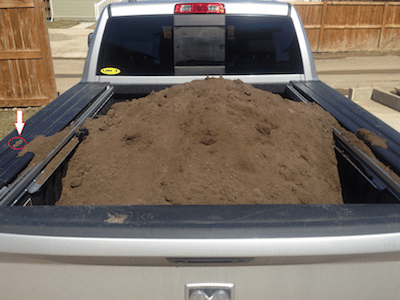
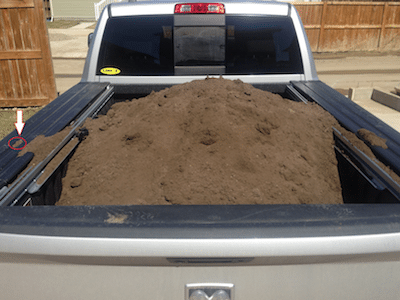
Roughly one tonne of soil — 1,000,000 grams. Soil that is lightly infested with clubroot has a low chance of selecting for a pathotype that could be virulent on clubroot-resistant canola.

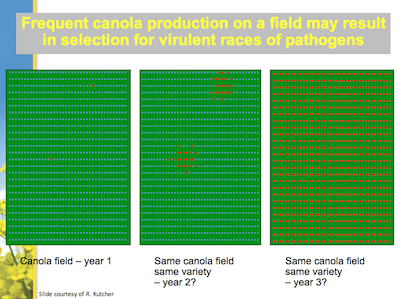
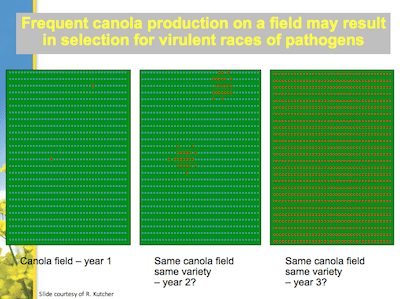
Resistance can lose its effectiveness when repeated cropping of a resistance source selects for individuals within a pathogen population that are virulent on that resistance. Initially, these new pathogen strains are very rare but then increase by being able to attack the “resistant” genotypes.

How to protect clubroot resistance

Continuing with the same resistant variety on the same field increases the risk of selecting for and building up new virulent pathotypes. Source: Randy Kutcher

Short of a stacked genetics solution and/or the development of several more distinct sources of resistance, which could take a lot of time and effort, we need to follow the risk mitigation practices to help prevent clubroot spread and protect this valuable genetic trait.

Hold back the economic clap from clubroot

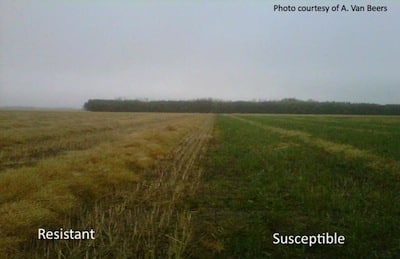
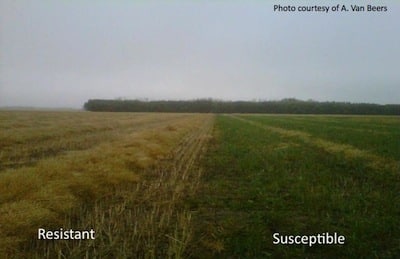
This is a clubroot infested field, with a resistant variety grown on the left and a susceptible variety grown on the right. Source: Aaron Van Beers

Clubroot lowers the bottom line for more and more Western Canada canola growers each year. The disease has been advancing through Alberta at a fairly steady 20 to 25 km per year, and has been detected at low levels in Manitoba and Saskatchewan. All Prairie fields are at risk of economic loss from clubroot, with the highest risk fields those that are (1) in known clubroot areas and (2) whose owners are currently doing very little, if anything, to prevent or manage the disease.