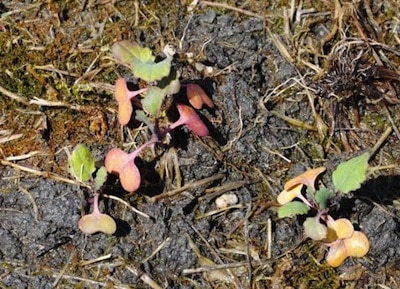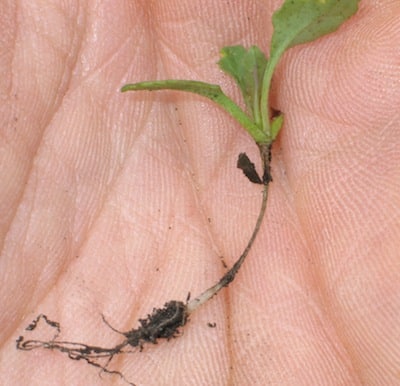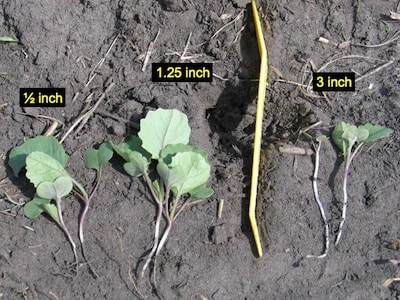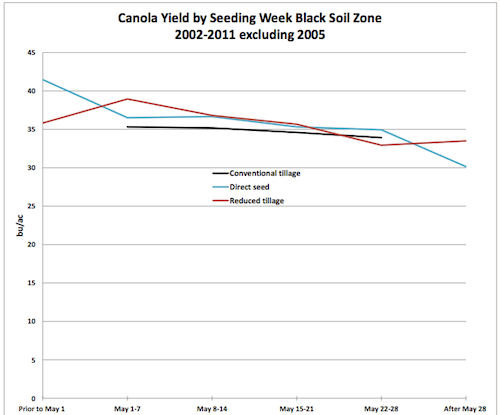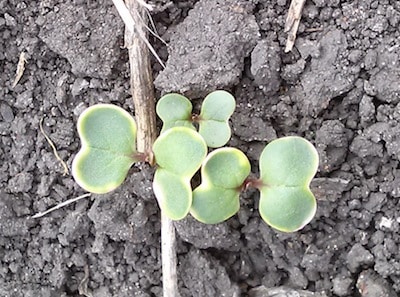
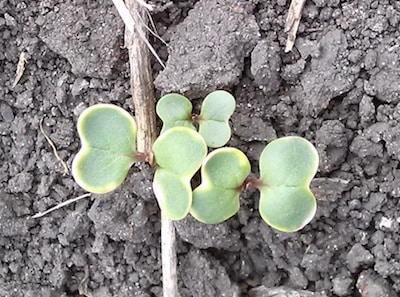
You may have observed canola with a yellow halo around the outside edge of cotyledons. If this happens when growing conditions are optimal and there hasn’t been frost, seed treatment is the likely cause. When the plant is growing very fast, translocation of seed treatment into the plant is also very fast. This can result in an occasional yellowing of the margins of the cotyledons. It does not affect plant health or efficacy of the product.
Tips to diagnose stand establishment issues
Many factors can cause a thin canola stand. Proper diagnosis is important for effective management. Here are common factors, with diagnosis tips for each.
Use our new Canola Diagnostic Tool on your smart phone or tablet for help in the field. Watch the video at the top of this article for a tutorial on how to use the tool.
Wind blows out seeds and seedlings
High winds can blow seeds and seedlings right out of the ground, especially if top soil is dry. If the field is not yet seeded, growers may want to seed a little deeper if topsoil is dry and high winds are still coming.
Dry and late: An exception to the shallow seeding rule
In a situation where soils are dry in top 1-2” and seeding is delayed to late May or June, the shallow seeding recommendation for canola is up for debate. Seeding as deep as 2” to chase moisture may be preferable to leaving canola stranded in half an inch of dust
Waterlogging and canola survival
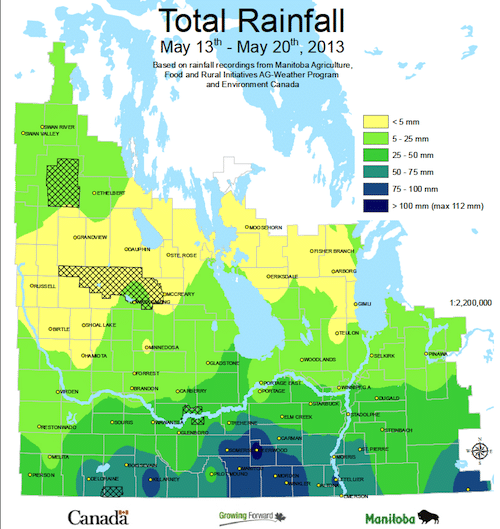
Sprouting seeds are vulnerable to flooding/ponding damage as they require oxygen for respiration. The longer it takes for emergence after germination, the greater the chance of stand loss. Saturated soils may also retard or prevent germination because oxygen concentration is too low around the seed. If no germination has occurred, seeds can be cut in half to determine if turgor pressure is still present. If the seed is extremely soft and does not hold form, it probably won’t survive.
Start scouting the week after seeding
The week after seeding is a good time to dig up seeds and seedlings to check for rots and blights. Disease damaged seed and seedlings die quickly, and may be gone within a few days, which is why this timing is important to an accurate diagnosis. For the first 21 days after emergence, scout regularly for flea beetles, cutworms, weeds, frost and many other possible threats to canola at this vulnerable stage.
Seed-place ammonium phosphate only
The bottom line for seed-placed fertilizer in canola:
1. Apply plant available sources of nutrients.
2. Place a modest rate of P in the seedrow. At rates over 20 lb./ac., the salt component in MAP, for example, can start to set back seedling survival.
3. Place N and S in a band away from the seed.
Principles of good seed placement
Growers are still better off seeding 1/2” to 1” deep and waiting for rain rather than trying to chase moisture in fields where the top layer of soil has dried out. The principles of good seed placement still apply. These are…
Spray AND seed at the same time
Canola benefits from both early seeding and early weed control. The solution: Work through seeding and spraying operations simultaneously. Have the seeder working when it can. Meanwhile walk fields to get an indication of weed pressure. Fields with large numbers of winter annual and perennial weeds should get a pre-seed burnoff. While spraying that field and waiting 3 days to seed, other fields that don’t have serious weed issues can be seeded and then sprayed after emergence.
Fan speed and seed damage
Some air drills can cause costly levels of seed damage if the fan speed is too high. Cracked seed will not germinate. Inspect the quality of seed in the tank to make sure the loading auger isn’t causing the damage. Next, use the sock test (watch the video above) to check the state of seed as it exits the opener. Remove one or more hoses from their openers and tape a tube sock to the end to collect seed. This will show what damage, if any, may have occurred as seed traveled through the drill. This can be done in the yard ahead of seeding or, to avoid wasting seed on the ground, in the field. Count damaged seeds carefully.
Even though the yellow split seeds will show up vividly in the sample, they may only represent a small percentage of seed. However if excessive damage has occurred, try a lower fan speed.