Trying a new treatment? Leave a test strip

Want to see how a foliar nutrient application helps a hailed crop? Leave a check strip. Want to see whether a novel treatment provided a return on investment? Leave a check strip.

Growers can use strip trials on their own farms to test how a particular practice or product performs in a local environment. This information can then be used to help decide whether it may be worthwhile to try this new practice or product on a larger proportion of the farm, and to target it at acres with the greatest likelihood of success.
How to help water-stressed canola

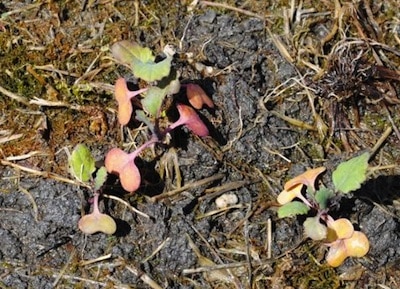
This canola spent a few days under water.

Wet soils cause an oxygen deficiency, which reduces root respiration and growth. Root failure reduces nutrient uptake, and plants will eventually die unless drowned areas dry out quickly.

Canola recovers from early hail

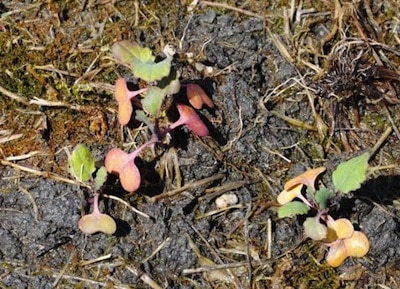
Early season hail rarely has an impact on canola yield potential. Hailed seedlings usually come back very well. If hail breaks off both cotyledons or snaps the stem, these plants usually do not survive. But even in these severe cases, while individual plants may die, a whole canola crop is fairly resilient to early season hail when it comes to overall yield potential.

The critical first 21 days

canoladiagnostictool small

The week after seeding is a good time to dig up seeds and seedlings to check for rots and blights. Disease damaged seed and seedlings die quickly, and may be gone within a few days, which is why this timing is important to an accurate diagnosis. While scouting for disease, also look for…

How to count plants

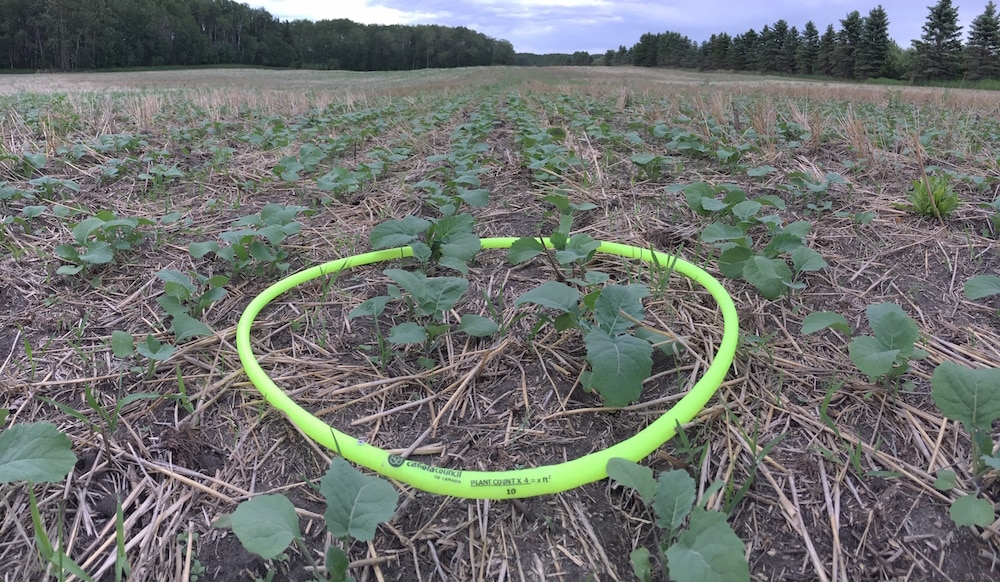
Start counting a week after seeding and repeat a couple of times over the following two weeks. Here’s how…

Crop insurance deadlines for canola

Manitoba and eastern Saskatchewan, in general, have a lower percentage of canola seeded than other parts of the prairie. Canola seeded June 5 or even June 10 in those regions can still produce a good crop, and crop insurance deadlines reflect that. Here are the deadlines…

TSW just one factor in plant population

TKW is added to the side of this blue tag.

With an average seeding rate of 5 lb./ac., an average thousand seed weight (TSW) of 5 grams, and 50% seed survival rate, the result is only 5.2 plants per square foot. This doesn’t leave much margin for error — especially given the ideal target is 7 to 10 plants per square foot.

Seed with a lighter TSW can improve your plant counts, but agronomy measures to improve seed survival can also make a big difference. Here are ways to increase seed survival and get more from a seed investment….

Late seeding? Tips to help canola mature faster

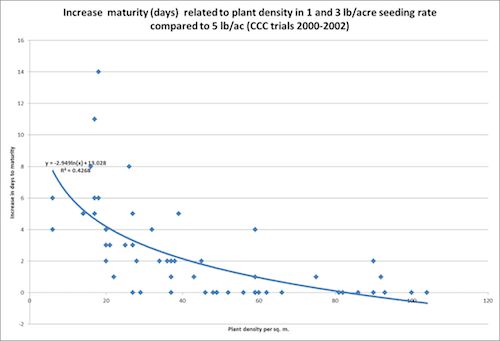
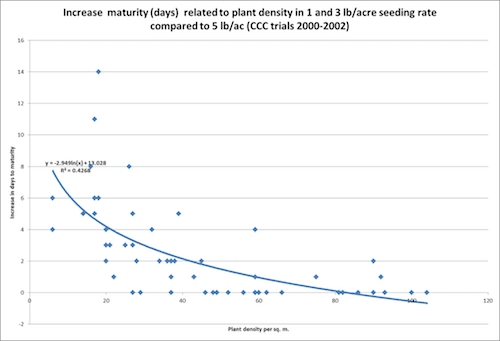
Canola stands with fewer than 4 plants per square foot (40 per square metre) can take 4 to 6 more days to mature.

This graph shows that a higher seeding rate that will ensure a stand of at least 60 plants per square metre (6 per square foot) will mature a lot earlier than a stand with 20-40 per square metre. A higher seeding rate is just one way to reduce the days to maturity for a late seeded canola field.

Residue rescue: Survey results

High cereal yields last year mean more residue issues this spring. If the drill cannot cut through or dig under the residue to place seed into soil, then some sort of residue management may be the lesser of two evils. We ran a survey the past two weeks asking Canola Watch readers for their thoughts on effective spring management for residue.

Following are the detailed responses we received. Note that the opinions expressed are not necessarily those of the Canola Council of Canada and may not represent the best management practices….

cold soils mean slow emergence

Cold soils? Seed anyway

Seeding into warmer soils speeds up emergence and makes it more uniform. However, the yield benefits of seeding early May versus late May (most years) are too important to ignore..

It’s mid May, so put away the soil thermometer. When you get the chance to seed, then seed.

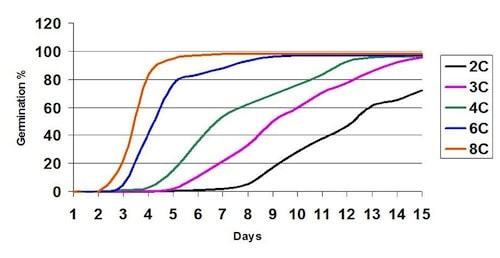
Seeding into warmer (8-10°C) soils will improve seed survival and have more seed emerging at the same time (as shown in the graph) but this needs to be balanced against the benefits of early seeding. To improve seed survival and speed of emergence in cooler soils, seed shallow and use seed-placed phosphate. Limit all other seed-placed fertilizer.